Math 37 - Lecture 5
Describing Data
13.0 4.9 13.3 14.5 11.0 10.0 14.3 12.6 18.6 10.0 12.6
11.4 12.5 12.6 15.2 13.7 12.6 11.4 13.9 11.3 14.2 12.4
12.4 12.3 13.9 13.1 13.9 11.4 11.9 13.7 10.9 13.4 12.5
14.5 13.4 13.5 13.6 15.9 15.7 12.0 14.4 12.5 10.2 8.8
12.0 11.1 11.6 15.3 13.3 11.1
Want to summarize the information in our data set.
To present info:
- Identify source of data
- Identify variables and the types of variables
Categorical=observations are put into categories
Quantitative=observations are numerical values
- Identify units
- Label everything
I. Tables - Summarize the information, well-labeled.
II. Graphs - See the overall pattern, deviations. Avoid overclutter, misleading information.
Categorical Data
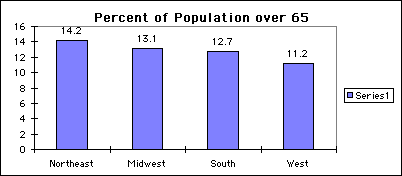
1. Bar graph - comparison to other groups (p. 185)
2. Pie Chart - comparison to the whole
Quantitative Data
1. Dotplots (see Lab 2)
2. Stem and Leaf Plots
a) Sort the data
b) Use the first part of the data as the stem
c) Write the stems vertically
d) Use the last part as Leaf (sometimes truncate)
e) Arrange leaves in increasing order
Example Length of time of Hitchcock movies
119, 105, 120, 120, 116, 108, 120, 130, 136, 103, 116,
108, 113, 132, 81, 108, 111, 101, 103, 126, 117, 128
In one of these movies, the action took place in one room and it was filmed without editing, can you identify it?
Advantages
- Quick visual picture of data (center, deviations)
- See actual numerical values
Disadvantages
- Best for smaller data sets (100)
- Can give poor picture
- Can split stems or truncate to change level of detail
3. Histograms
a) Divide data into classes
Each data point belongs to exactly one class
Convention: Include left hand endpoint and not right
b) Count number of observations in each class, frequencies
c) Area of each block is proportional to frequency
Easiest: Classes of equal length, then height=frequency
Example Weights of the 1996 Men's Olympic Rowing Team for 7 rowing events (single, lightweight double, and quadruple sculls, pair, four, lightweight four, eight with coxswain)
154 224 214 195 160 155 195 205 195 195 200 210 210 205 200 215 220 205 210 160 160 158 208 121 207 207
Can you identify distinct groups of rowers?
Advantages
- No set width of class intervals
- More flexibility than for stem and leaf plots
- May have natural classes
Disadvantages
- Don't see actual data values
- Take a little more time by hand
Look for
- Central location
- Variability
- Skewness vs. symmetry
- Patterns and deviations