Math 37 - Lecture 32
ANOVA cont.
Review: Situation - compare several population means
H0: m1=m2=…=mI I=number of groups/populations
Ha: at least one mi differs
Test statistic = F = variability between group means df=I-1
variability within groups df=N-I
Sampling distribution of this test statistic follows an F(I-1,N-I) distribution. P-values for this distribution are found in Table E.
Technical Assumptions
Example: Comparing truck gas mileage
F= 2.50, p=.124, conclusion: Fail to reject H0
Checking Technical Assumptions
MTB> oneway c1=c2 c3(
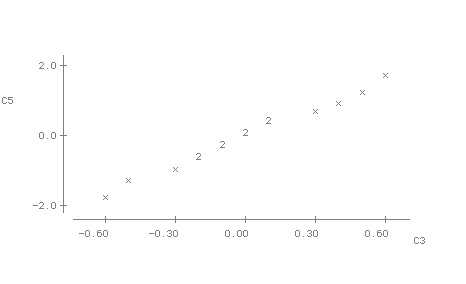
data in c1, subscripts in c2, stores residuals in c3)To check normality: Could do a plot for each group (e.g. truck). Analyzing residuals lets us examine normality of the combined data from all groups.
Normal Prob Plot of residuals
To check equal variances:
Will consider this assumption reasonably met if
Largest standard deviation < 2
Smallest standard dev
Truck SDs: .35, .25, .44
Example Paula can take either Main St or High St to work, and she wants to know if one route gets her to work faster?
Response variable= type=
Explanatory variable= type=
She randomly chooses different routes for her drive to work for the next four weeks, makes a total of ten trips with each route.
Main St: 26.0 24.2 26.5 24.1 24.2 19.9 16.7 20.7 20.5 17.2 High St: 18.8 20.0 22.7 22.3 21.2 17.4 17.3 12.7 15.6 12.0
Numerical and Graphical Summaries
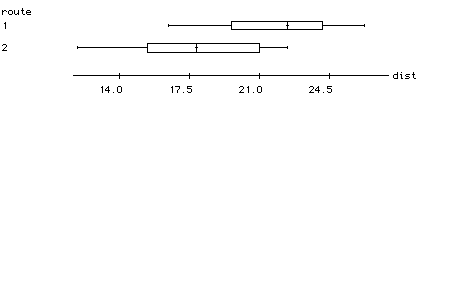
 1=22 min s1=3.49 min
2=18 min s2=3.74 min
ANOVA Table
|
Source |
DF |
SS |
MS |
F |
P |
|
Route |
84.05 |
84.05 |
|||
|
Error |
241.28 |
13.40 |
|||
|
Total |
325.33 |
Can you check technical assumptions?
Example 2 Dispuva, Feely, and Hwang (1997) conducted a study to see if there is a difference in car speeds depending on the gender of the driver or the color of the car. They took a sample of 100 cars traveling west on Alpine Street between 12:30 and 2:30. At one tree, one observer began a stopwatch the moment the car passed the tree. At a second tree, 234' away, a second observer lowered his arm the moment the car passed to signal the first observer to stop the time. A third observer recorded the gender of the driver (to the best of his abilities). One-way ANOVA:
ANALYSIS OF VARIANCE ON speed
|
SOURCE |
DF |
SS |
MS |
F |
P |
|
Gender |
1 |
13.28 |
13.28 |
1.25 |
.2662 |
|
Error |
98 |
1041.0 |
10.63 |
|
|
|
Total |
99 |
1054.28 |
|
|
|
Here is the output from a pooled t-test (assuming equal variances and using sp2 for SE(1 - 2) ):
TWO SAMPLE T FOR male VS female
|
Gender |
N |
MEAN |
STDEV |
SE MEAN |
|
Male |
51 |
35.353 |
3.303 |
.463 |
|
Female |
49 |
36.082 |
3.213 |
.459 |
P5 PCT CI FOR MU male - MU female: (-2.0228, .5648)
TTEST MU male = MU female (VS NE): T=-1.12 P=.2662 DF =98
POOLED STDEV = 3.2592