Math 37 - Lecture 30
Chi-Square Examples
Example 1 Betty Jarusiewicz, a UOP alum, has been investigating the role of spirituality (release to a higher power of control, gratitude, humility, tolerance) and recovery rates of addicts. One of her questions was whether identification with a particular religion was related to recovery. Of 21 subjects who did not identify with a particular religion, 7 relapsed within 2 years. Of the 19 subjects who did identify with a particular religion, 13 relapsed.
(a) Construct a bargraph to describe the relationship between identification with a particular religion and recovery. Describe the association you see in your own words.
(b) Investigate if identification with a particular religion is related to recovery using a chi-square test.
(c) Identify if there is a difference in the proportion who recover in the two religion identification groups using a two-sample z-test for proportions.
(d) What happens if you square the z-statistic - how does it compare to the chi-square statistic from (a)? How do the p-values compare?
(e) Verify the technical assumptions for both test procedures.
Example 2 Is a man’s marital status related to the level of his job? A study examined 8235 males in a large manufacturing firm and classified their marital status into four groups, and their job grade into 4 groups (grade 1 refers to the lowest quarter of job grades, grade 4 refers contains those in the highest quarter; these grades are set by the company to indicate the value of the particular job to the company)
|
|
Marital Status |
|||
|
|
Single |
Married |
Divorced |
Widowed |
|
1 |
58 |
874 |
15 |
8 |
|
2 |
222 |
3927 |
70 |
20 |
|
3 |
50 |
2396 |
34 |
10 |
|
4 |
7 |
533 |
7 |
4 |
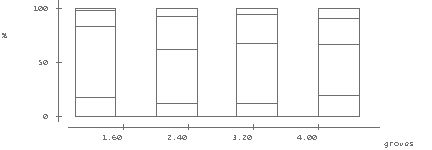
(a) Examine the bargraph on the next page. First, finish labeling the picture (may need to calculate a conditional percentage) and then see if you identify an association visually. Describe the association in words.
(b) To run chi-square analyses in Minitab, we just type in the two-way table. So here we will put the marital status in columns 1-4. Then type MTB > chisq c1-c4
Expected counts are printed below observed counts
|
single |
married |
divorced |
widowed |
Total |
||
|
1 |
58 |
874 |
15 |
8 |
955 |
|
|
39.08 |
896.44 |
14.61 |
4.87 |
|||
|
2 |
222 |
3927 |
70 |
20 |
4239 |
|
|
173.47 |
3979.05 |
64.86 |
21.62 |
|||
|
3 |
50 |
2396 |
34 |
10 |
2490 |
|
|
101.90 |
2337.30 |
38.10 |
12.70 |
|||
|
4 |
7 |
533 |
7 |
4 |
551 |
|
|
22.55 |
517.21 |
8.43 |
2.81 |
|||
|
Total |
337 |
7730 |
126 |
42 |
8235 |
ChiSq = 9.158 + 0.562 + 0.010 + 2.011 +
13.575 + 0.681 + 0.407 + 0.121 +
26.432 + 1.474 + 0.441 + 0.574 +
10.722 + 0.482 + 0.243 + 0.504 = 67.397
df = 9
2 cells with expected counts less than 5.0
(c) Follow-up analysis: Since the result is significant, we will do some follow-up analysis to see why. Looking at the 16 components of the Chi-Square sum in the computer output, which four cells are the largest? This means that for those four cells, the discrepancy between the observed and the expected counts was the largest. Explain in your own words what this tells you about which groups seem to be behaving differently - e.g. who is more likely to get a higher-grade job. Does this agree with the picture in the bar graph?
Example 3 Rosales, Yarbrough, Yarbrough, Martella (1997) wanted to know if the appearance of an apple affected a person's judgement of its taste. They set up a taste test where each subject choose their favorite tasting apple, once when they could see the apples and once when they were blindfolded. During the blind taste test, Apple A was chosen as the favorite 2 times, Apple B 8 times, Apple C 7 times and apple D 3 times. Without the blindfold, they favorite apple was A:2, B:6, C:3, D:9. Set up a two-way table to determine if apple preference is affected by sight.