Sample
size
Count
Proportion
1(new)
n1=10
X1=7

2(old)
n2=10
X2=5
Math 37 - Lecture 22
Two Sample Comparisons (7.2, 8.2)
Goal: To compare the responses to two treatments or to compare the characteristics of two populations.
* Have a separate, independent sample from each population
e.g. randomized comparative experiment, comparing groups (M vs. F)
Procedure:
Ask yourself: means or proportions, one or two distinct populations?
1. Graphical comparisons
2. Numerical comparisons
3. Inference - do the groups differ more than we would expect by chance alone?
Need to know how the statistic behaves in repeated samples
Example Medical researcher wants to compare a new treatment to the old treatment. Randomly assigns 10 patients to each treatment. She observes how many in each group exhibit satisfactory recovery. She finds 7 patients in the new treatment and 5 patients in the old treatment recover.
1. Numerical Summary
|
Sample |
size |
Count |
Proportion |
|
1(new) |
n1=10 |
X1=7 |
|
|
2(old) |
n2=10 |
X2=5 |
|
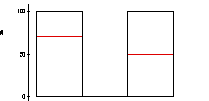
new old treatment
3. Inference
Are you convinced this difference in recovery rates is not just due to chance?
Parameter:
Statistic:
Null Hypothesis:
Alternative Hypothesis:
How does this statistic behave under repeated samples if the null hypothesis is true?
Overall recovery rate:
Are the recovering patients distributed among the two groups randomly?
Sampling Distribution of 1 - 2 when p1=p2
No. of
samples
1-2
Shape?
Center?
Variability?
Test Statistic:
Assume H0 is true,
Pooled estimate:
Standard error:
Confidence Interval for p1-p2:
Technical assumptions: SRS, normal approximation to Binomial
Rule of thumb: number of successes and failures in each sample > 5
Example Want to study the long term effects of preschool programs for poor children. Follow two groups of Californian children since early childhood: control group of 61 did not attend preschool. Another groups of 62 attended preschool as 3 and 4 year olds. Response variable is need for social service as adults: 49 of the control sample and 38 of the preschool sample needed social services.
- Does this data satisfy the technical assumptions?
- Test for a difference in the need for social services between these two groups
- How large is the difference? Estimate at the 95% confidence level.