INVESTIGATING STATISTICAL CONCEPTS, APPLICATIONS, AND METHODS
BRIEF SOLUTIONS TO INVESTIGATIONS
Last Updated April 17,
2008
CHAPTER 1
Investigation 1.1.1: Popcorn Production and Lung Disease
(a) 21/116 = .181
(b) proportion in each group
(c)
|
|
Low exposure |
High exposure |
Total |
|
Airway obstructed |
6 |
15 |
21 |
|
Airway not obstructed |
52 |
43 |
96 |
|
Total |
58 |
58 |
116 |
(e) There appears to be a higher rate of airway obstruction in the “high exposure” group.
(f) Low exposure: 6/58 =.103; High exposure: 15/58 = .259
(g) .259-.103 = .156, seems reasonably large
(h) .650-.494 = .156, same difference but doesn’t “feel” as large?
(i) .259/.103 = 2.51
(j) 21/95 = .22
(k) (15/43)/(6/52) = 3.02
Investigation 1.2.1:
Smoking and Lung Cancer
(a) males
(b) EV = amount of smoking (categorical); RV = whether have lung cancer (categorical)
(c)
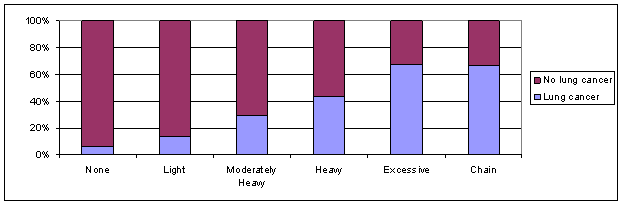
(d) 14/90 = .156; 8/114 = .070; ratio = 2.217
(e) (14´114)/(8´90)
(f) (213´114)/(8´278)=10.92
(g) (122´114)/(8´60)=28.98, the odds of lung cancer are almost 30 times higher for the chain smokers compared to the non-smokers
(h) The odds of lung cancer are 12.77 times higher for the smokers compared to the non-smokers
(i) Yes, as the amount of smoking increases so does the odds ratio (compared to non-smokers)
(j) There could be something else different about those who choose to smoke, e.g., diet, exercise
(k) Older people are more likely to smoker (before all the negative publicity) and to have cancer (just by being around longer!)
(l) No, the researchers forced the amounts of patients with and without lung cancer to be similar instead of seeing how often these outcomes occurred “naturally.”
(m) No, can always be other explanations (e.g., diet, exercise)
(n) Not clear how representative these patients were…
Investigation 1.2.2: Lung Cancer and Smoking (cont.)
(a) EV = smoking; RV = lung cancer death or not.
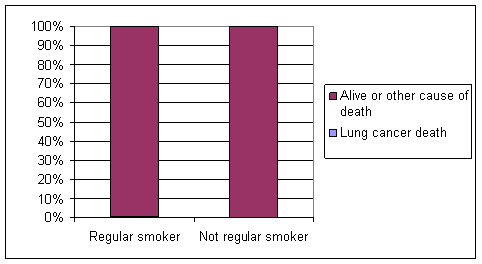
(b) Cohort study since identified and followed the explanatory variable groups and observed the resulting response.
(c) .005 - .00047 = .0046, a very small difference
(d) RR = (.005/.00047) = 10.64, OR = 10.77 (will be some rounding differences)
(e) Don’t have to rely on memory, can see how health changes over time, all patients are healthy to begin with
(f) Same as before, could be other differences about those who smoke
(g) Yes
Investigation 1.3.1:
Near-Sightedness and Night-Lights
(a) ou = children; variables = eye condition (categorical) and light condition (categorical)
(b) EV = lighting, RV = eye condition
(c) Probably best described cross-classified since both variables were recorded about each child simultaneously
(d)
|
|
Room light |
Night-light |
Darkness |
Total |
|
Far-sighted |
12 |
39 |
40 |
91 |
|
|
22 |
115 |
114 |
251 |
|
Near-sighted |
41 |
78 |
18 |
137 |
|
Total |
75 |
232 |
172 |
479 |
(e)
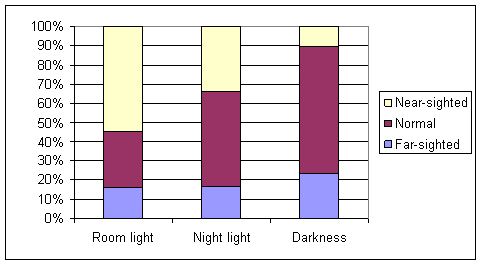
The occurrence of myopia (near-sightedness) appears to increase as the amount of light in the child’s room increases.
(f) .286, .55, .336, .105, .16, .168, .232
About 29% of children were near-sighted, but this proportion increased to .55 for the children with a room light, but was only .105 when no lighting was used. The occurrence of hyperopia was fairly constant with a slightly increased proportion among children who slept in darkness.
(g) Could be other causes such as genetics, other child-rearing issues that are related to both the type of lighting used and the eye condition of the children.
Investigation 1.3.2: Graduate Admissions Discrimination
(a) men: .445, women: .252
(b) Yes, men were accepted to these
(c) program, gender, whether accepted
(d) .619, .059, .824, .070
(e) the issue is that women applied more often to the program that was harder to get into overall.
(f) Since more women applied to program F than program A, the overall acceptance rate for women will be closer to that of program F than that of program A.
(g) (108/449)(.824) + (341/449)(.070) = .25
(h) [825(.619)+373(.059)]/1198 = .44
(i) The two equations will be AmPm + Fm(1-Pm) and AwPm + Fw(1-Pm). Since Am < Aw and Fm < Fw, the first term is guaranteed to be smaller.
(j) The two equations will be AmPm +Am(1-Pm) = Am and AwPw + Aw(1-Pw) = Aw. Since Aw > Am, this will be true about the overall rate as well.
Investigation 1.4.1:
Foreign Language and SAT Scores
(a) EV = foreign language study (categorical); RV = SAT verbal (quantitative)
(b) Possibilities include ambition, overall academic achievement, verbal ability. For example, maybe those who take a foreign language are more likely to be interested in attending college and therefore study harder for the SAT.
(c) Randomly assign students to take a foreign language or not
(d) Want the two groups to be as similar as possible.
(e) The power of suggestion could be enough to help improve their performance.
Investigation 1.4.2:
Have a Nice Trip
(a) This would be a problem as gender would be confounded with the recovery strategy employed. If one group did better you wouldn’t be able to decide whether it was the strategy used or their gender.
(b) Want everything about the two groups to be as similar as possible.
(c)-(d) Results will vary
(e) Difference won’t always be zero but distribution should be centered around zero and should be equally likely to be positive as negative.
(f)-(g) Results will vary but the two outcomes will probably not be identical.
(h) Distribution should center symmetrically around zero.
(i) Center: 0, Largest: around .67, smallest: around -.67
(j) No, but most randomizations produce a difference that is close to zero
(k) Yes, as seen by the distribution being centered around zero
(l) Yes, as seen by the distribution being centered around zero
(m) Yes, as seen by the distribution being centered around zero
Investigation 1.4.3: Have a Nice Trip (cont.)
(a) Make sure you have the same number of men and women in the two groups
(b) Equal
(c) The difference in proportions will always be zero, by your design.
(d) Should be less variation than when didn’t block on gender
(e) Since height is related to gender, by making the groups more similar with respect to gender, will also be more similar with respect to height.
(f) This time, the distributions look pretty similar. Presumably gender is not related to either of these two variables.
Investigation 1.5.1:
Friendly Observers
(a) The subjects were assigned to group A or group B and were not told how the two groups were being treated differently. Since the response variable (score on game) was measured objectively, there is not really a subjective rater who should be blind to group membership.
(b) EU = subjects, var1 = vested interest or not (categorical, EV), var 2 = beat threshold or not (categorical, RV)
(c) .25, .67; 6
(d)
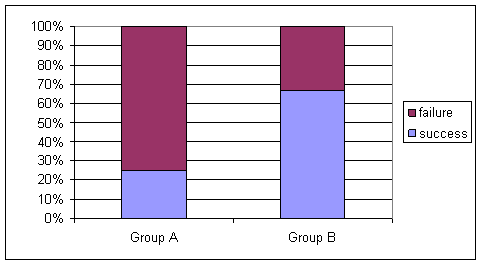
(e) .25-.67 =-.42
We observe a smaller proportion of successes (threshold beaters) in Group A (observer with vested interest) as conjectured by the researchers.
(f) Yes, randomization may not have completely balanced out the variables in the two groups and the difference we are seeing could be based on some of these extraneous variables and not on the observer’s interest level.
(g)-(j) Answers will vary
(k) 5 or 6, half of the 11 total
(l) somewhat
(m) somewhat
(n) yes, since it would be very unlikely to be a product of an “unlucky” randomization (as judged by the dotplot, a result this extreme is unlikely to happen the randomization process alone)
(o) results will vary
(p)-(q) example results
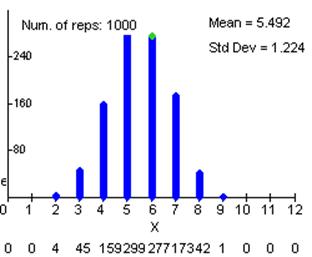
relative frequency: 0, 0, .004, .045, .159, .299, .277, .173, .042, .001, 0, 0, 0
(r) About 5.5
(s) about .05
(u) some evidence since it’s unlikely to get that few successes in Group A when there really is no difference between the two groups.
Investigation 1.6.1:
Random Babies
(a) answers will vary
(b) probably not
(c) example results
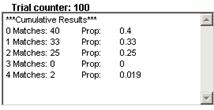
(d) Most likely: 0 or 1,
least likely: 4
(e) should be close to 1
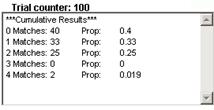
(f) Graph bounces around when the number of trials is small but then begins to converge to .375.
(g) results will vary, should be around .04.
(h) impossible since if 3 mom’s match, the fourth must as well.
(i) should eventually converge to 1.
(j)
1234 1243 1324 1342 1423 1432
2134 2143 2314 2341 2413 2431
3124 3142 3214 3241 3412 3421
4123 4132 4213 4231 4312 4321
(k) 1/24
(l) 2143, 2341, 2413, 3142, 3412, 3421, 4123, 4312, 4321
(m)
4 2 2 1 1 2
2 0 1 0 0 1
1 0 2 1 0 0
0 1 1 2 0 0
(n) There are 9 zero’s so the probability is 9/24.
(o) P(X=1) = 8/24
P(X=2) = 6/24
P(X=3) = 0/24
P(X=4) = 1/24
(p) Answers will vary
(q) should be similar
(r) 15/24
(s) 15/24 = 1-(9/24)
(t) 0(9/24) + 1(8/24) + 2(6/24) + 3(0/24) + 4(1/24) = 24/24 = 1.
(u) should be similar
(v) no, no
Investigation 1.6.2:
Animal Models for Stroke Treatment
(a) X can range from 3 to 7 (since are at most 7 rats in either group)
(b)-(c) results will vary
Example results
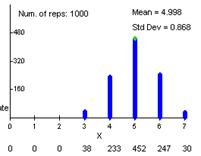
(d) It is very surprising to find all 7 in one group (happens about 3% of the time by chance alone)
(e) C(14,7) = 3432
(f) C(10,7) = 120
(g) P(X=7) = 120/3432 = .035, close to the above simulation results
(h) We would be willing to draw a cause and effect conclusion since we have evidence this result didn’t happen just by chance and since it was a randomized comparative experiment, there shouldn’t be any confounding variables.
Investigation 1.7.1: More Friendly Observers
(a) 2,704,156; no
(b) C(11,3) = 165
(c) Also need to consider the number of ways to assign the 9 of the failures to group A.
(d) C(13,9)
(e) C(11,3)C(13,9)
(f) P(X=3) = C(11,3)C(13,9)/C(24,12) = .0436
(g) This is just 3 exactly, we want 3 or fewer (a result at least as extreme as what was observed)
(h) C(11, x)C(13, 12-x)/C(24,12)
(i) C(M, x)C(24-M, 12-x)/C(24,12)
(j) C(M, x)C(N-M, 12-x)/C(M,12)
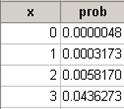
(k) .00582, .00032, .0000048
(l) .0498
(m) Rather unlikely to occur as a result of the randomization process alone
(n)
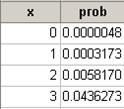
(o)
Hypergeometric with N = 24,
M = 12, and n = 11
x P( X <= x )
3 0.0497664
(p) should be similar
(q) probabilities should sum to 1
(r) E(X) = 5.5
12(11/24) = 5.5
(s) {Y  7}, 7
7}, 7
(t)
Hypergeometric with N = 24,
M = 12, and n = 11
x P( X <= x )
7 0.950234
1-.9502 = .0498.
(u)
|
|
Group A |
Group B |
Total |
|
Beat threshold |
6 |
16 |
22 |
|
Did not beat threshold |
18 |
8 |
26 |
|
Total |
24 |
24 |
48 |
(v) 6/24 = .25; 16/24 = .67
(w) Would look identical
(x) prediction
(y) Let X = number of successes in Group A. Want P(X< 6) = .0042
(z) This p-value is quite a bit smaller and provides much stronger evidence that the experimental results did not happen by chance alone.
Investigation 1.7.2:
Minority Baseball Coaches
(a)
|
|
Minority |
Not minority |
Total |
|
1st base |
15 |
15 |
30 |
|
3rd base |
6 |
24 |
30 |
|
Total |
21 |
39 |
60 |
X = number of minorities at 3rd, want P(X< 6) = .015
This p-value is small enough to convince us that these results would not arise from a chance mechanism alone.
(b) This was an observational study (since race was not imposed by the researchers) so we can’t conclude “cause-and-effect” but we can say that the race and base position variables appear to be related.
CHAPTER 2
Investigation 2.1.1: Anticipating Variable Behavior
Answers will vary but should be justified, e.g., the number of possible distinct outcomes, the shape of the distribution, the perceived variability in the distribution, the frequency of the category corresponding to the value of zero…
Investigation 2.1.2: Cloud Seeding
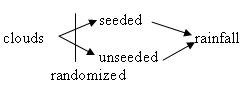
(a) This is an experiment since the researchers imposed the seeded/unseeded condition on the clouds (the experimental units).
(b) EV = whether or not seeded (categorical); RV = volume of rain (quantitative)
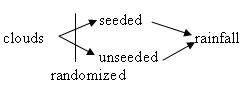
(c) Randomization was used so that the characteristics of the cloud groupings would be as similar as possible prior to imposing the treatment.
(d) To prevent any hidden “bias” that could creep into the pilots’ behavior or those making the measurements. Seems less of an issue in this context, but doesn’t hurt.
(e) The seeded clouds show a slight tendency for larger volumes of rainfall. The distribution is centered at a slightly higher value and has more of the extreme results (e.g, 1600 and above).
(f) unseeded: min = 1.0, Q1 = 24.4, median = (41.1+47.3)/2 = 44.2, Q3 = 163, max = 1202.6
seeded: min = 4.1, Q1 = 92.4, median = (200.7+242.5)/2 = 221.6, Q3 = 430, max = 2745.6
All values are in units of acre-feet.
(g) The seeded clouds have higher values for all 5 numbers in the five-number summary indicating a tendency for larger amounts of rainfall.
(h) 1.5(430-92.4) = 506.4
92.4-506.5 < 0, no low outliers
430+506.4=936.
Any clouds with more than 936.4 acre-feet of rainfall are outliers. There are four such outliers.
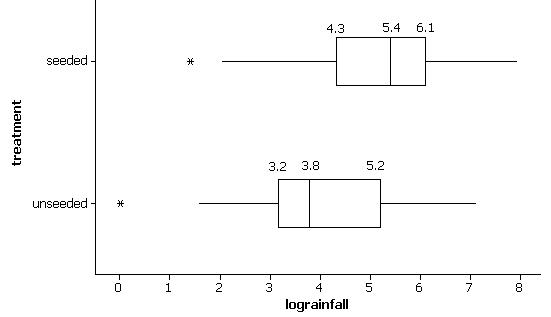
(i) Show min at 4.1, box from 92.4 to 430 with line at 221.6, whisker to 703.4 and then outliers at 978, 1656, 1697.8, and 2745.6.
(j) The boxplots show graphically that the distribution of the seeded clouds is shifted slightly to the right from the unseeded clouds. The box is also wider indicating more variability in the rainfall volumes.
(k) Asks for prediction
(l) The means are larger than the respective medians.
(m) 6 out of 26 (23%) in both cases. This indicates that the mean is not falling in the “middle” of the distribution as the median would
(n) possibly not as well as the median which is guaranteed to be “in the middle” of all the data values.
(o) Using Minitab:
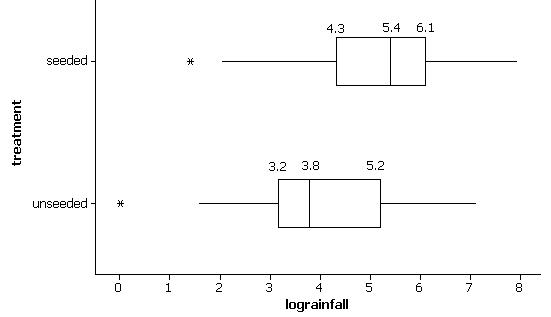
(p) The spreads of the distributions (as judged by the width of the boxes and the whiskers themselves) are more similar, and the shapes are slightly more similar (both a bit more symmetric).
(q) Yes, the seeded clouds show a higher tendency for log(rainfall) as well.
Investigation 2.1.3: Geyser Eruptions
(a) This is an observational study since the researchers did not randomly impose the year on some eruptions, but observed the eruptions as they occurred.
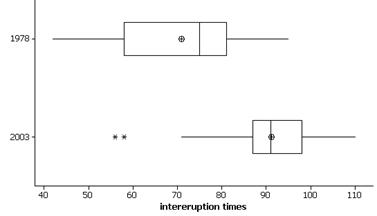
(b) Also transposing the variables, the boxplots are:
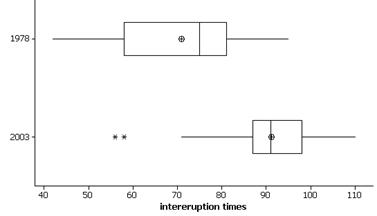
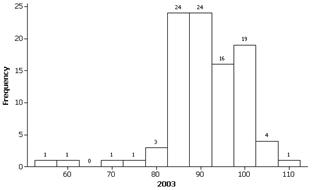
These boxplots show a tendency for longer intereruption times in 2003 as the box is shifted to the right and the lower quarter of 2003 is still above the upper quartile of 1978.
(c) Yes since the boxwidth (the interquartile range) is smaller in 2003, this is evidence that the times are less variable/more consistent. There are 2 outliers in 2003 of unusually short intereruption times for that year.
(d) 1978: 95-42 = 53; 2003: 110-56 = 54 minutes.
(e) new 2003 range = 39, much smaller than before.
(f) No, because based on (e), the range appears to be highly sensitive to outliers in the data set.
(g) From Minitab: 1978: 23; 2003: 11
(h) yes, 2003 has a smaller interquartile range so it appears to have more consistent times. Smaller spread corresponds to smaller IQR.
(i) minutes2
(j) 1978: 12.97 minutes; 2003: 8.46 minutes
(k) smaller spread corresponds to a smaller standard deviation value.
(l) new SD = 6.87, new IQR = 11.
The IQR hasn’t changed but the SD is now almost 2 minutes smaller.
(m) These approximations should be read from the graph and five number summary. About 25% of the 1978 intereruption times were less than 60 minutes compared to all but 2 of the 2003 values. Similarly, 50% of 1978 eruptions were less than 75 minutes, and even less than 25% of the 2003 eruptions were.
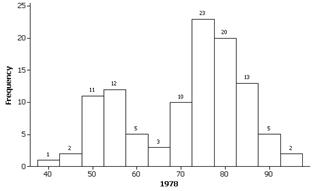
(n) Histograms:
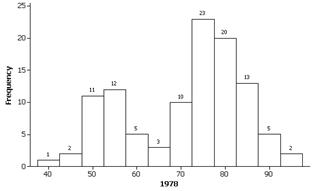
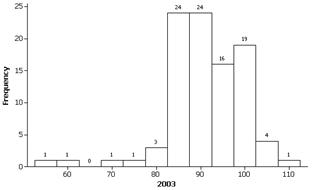
We get roughly the same percentages as above.
(o) Both the histograms (especially 1978) do reveal a bimodal shape that was hidden in the boxplot display.
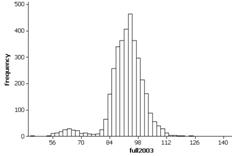
The distribution of intereruption times is bimodal. The second, very short, peak is around 60 minutes.
(p)
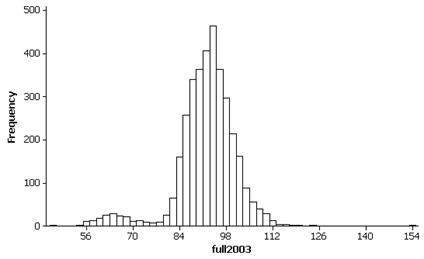
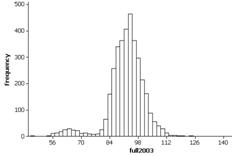
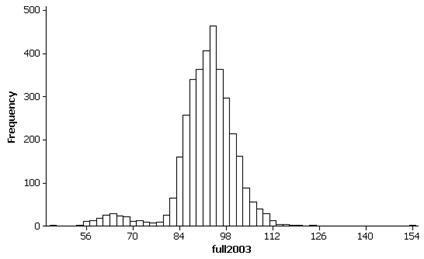
This histogram is also bimodal with a peak around 60 minutes and a much larger concentration of intereruption times around 85-105 minutes. There are a few extreme outlying times below 50 minutes and around 154 minutes.
Investigation 2.1.4: Hypothetical Quiz Scores
(a)-(d) Asks for prediction.
(e)
|
|
Class A |
Class B |
Class C |
Class D |
Class E |
Class F |
|
Q1 |
4 |
2 |
3 |
1 |
5 |
6 |
|
Q3 |
7 |
8 |
7 |
9 |
5 |
8 |
|
IQR |
3 |
6 |
4 |
8 |
0 |
2 |
Class A has the least variability of A-C. Class D has more variability than class C. Based on the IQR, Class E has the least variability of all.
(f) This results are consistent, with Class F having the least, then class A.
Investigation 2.1.5:
Body Temperatures
(a) Calls for personal opinion.
(b) Could look at dotplots, boxplots, or histograms.
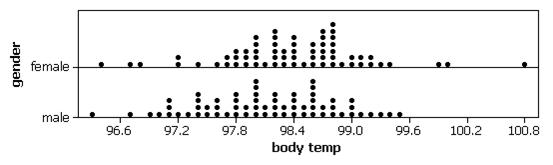
With dotplots:
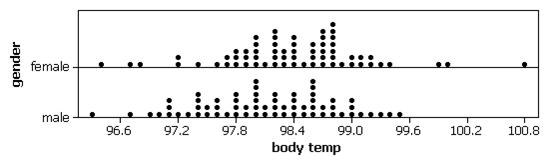
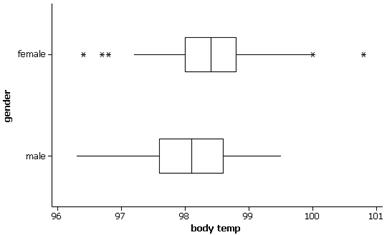
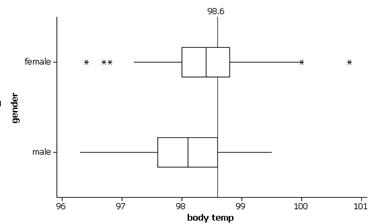
We see that both distributions are rather symmetric, with the females appearing to have a slight tendency for higher body temperatures. The mean body temperature for the females in this sample is 98.394 degrees compared to 98.105 degrees for the males (median 98.40 vs. 98.10). The female body temperatures also show slightly more variability (SD=.743 degrees vs. .699 degrees, though the IQR has .8 for the females and 1.0 for the males). If we look at the boxplots, we see that the larger standard deviation for the females arises in large part from about 5 outliers.
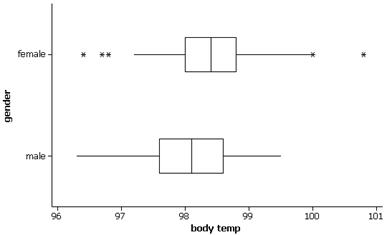
(c) A temperature of 98.6o appears rather typical for the females but is close to the upper quartile (98.6) for males. Would be nice to know the conversion between the Fahrenheit and Celsius scales to answer the second question.
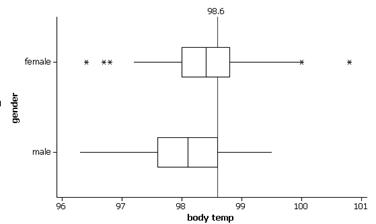
(d) female: (98.6-98.394)/.743 = .277
male: (98.6-98.105)/.699 = .708
(e) With a higher z-score, a temperature of 98.60 is “further” above the male average than the female average.
(f) female: (98-98.394)/.743 = -.53
male: (98-98.105)/.699 = -.15
A temperature of 980 appears to be more unusual for the females since the absolute value of the z-score is larger.
(g) A negative z-score indicates the observation lies below the mean.
(h)
|
|
Mean |
Standard dev |
|
Female |
36.885 |
.413 |
|
Male |
36.725 |
.388 |
(i) The new mean is (5/9)(98.395-32) for the women and (5/9)(98.105-32) for the men, transformations of the means on the Fahrenheit scale. For the standard deviations, we use just the scale term: (5/9)(.743) and (5/9)(.699).
(j) (5/9)(98.6-32) = 37
(k) female: z = (37-36.885)/.413 = .28
male: z = (37-36.725)/.388 = .71
These are the same (apart from some rounding discrepancies) as the z-scores obtained on the Fahrenheit scale.
(l) 0
(m) 68%
Investigation 2.1.6:
The Fan Cost Index
(b)
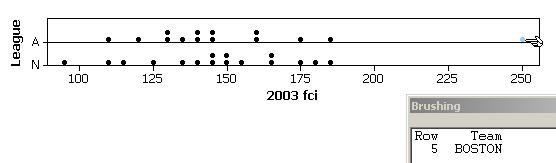
(c)
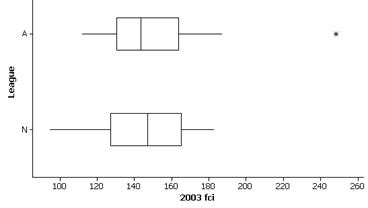
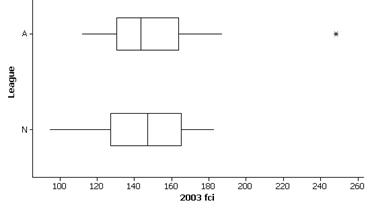
(d) The five number summary (in dollars) and mean/SD are below.
Variable League
Minimum Q1 Median
Q3 Maximum
2003 fci A 112.02
130.37 143.69 163.73
248.44
N 94.61
127.32 147.32 165.11
182.56
Variable League
Mean StDev
2003 fci A
151.92 34.60
N 145.81
24.88
(e) The costs are rather similar in
that there is much overlap of the boxes and while the median FCI value is
slightly higher for the National League, the mean American League FCI value is
higher. The standard deviation for the
American League is slightly larger though the IQR is slightly lower ($33.36 vs.
$37.79). Both distributions appear
fairly symmetric.
(f) American; National; The FCI for
(g) National; American; The FCI for
(h) Calls for predictions.
(i)

Now
(j) Median since it is calculated
based on the position of the observations and not their numerical values. An extreme numerical value will always affect
the calculation of the mean.
(k) The IQR since it is calculated
based on the position of the observations and not their numerical values. An extreme numerical value will always affect
the calculation of the standard deviation and the range..
(l)

mean=$3.45, sd = $8.93, median =
$2.13, IQR = $13
The distribution of price
differences is fairly symmetric, centered near zero, but with a fairly large
spread. If we compare the two leagues:

There is much more variation in the
differences for the American League than the National League (SD $11.08 vs.
$6.88, IQR $15.76 vs. $11.35). Both
distributions center around 3 dollars, although the median
(m) Largest percentage change:
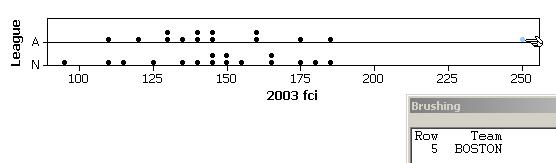
Largest 2003 FCI:
Largest change:
While
(n) Also shifting to a more sensible
scale:
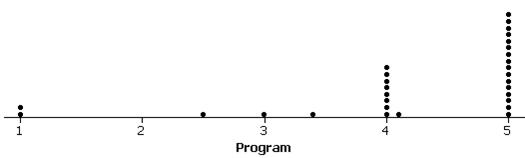
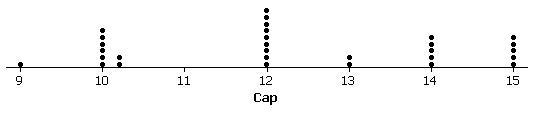
These prices tend to occur at
integer values. This makes sense as they
are often sold by vendors walking the stands and it is more convenient to not
have to make change.
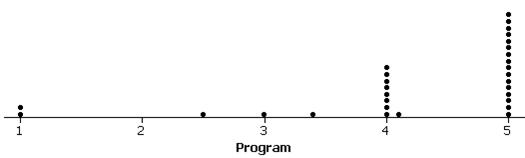
(o) There is a $4.08 program (
(p) They are the Canadian teams and
the prices have been converted to US dollars.
These values are probably integers in Canadian dollars.
(q) No
(r) They are not all actually the
same size.
(s)
Investigation 2.2.1
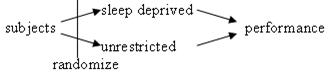
Sleep Deprivation and Visual Learning
(a) Experiment since the subjects
were assigned to either get sleep the first night or not.
(b) EV: sleep (categorical); RV:
performance score (quantitative)
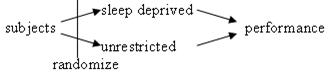
(c) The unrestricted group tended to
have larger improvement values than the sleep deprived group. In fact, only one member of the unrestricted
group failed to improve where as 3 of the deprived group decreased in
performance by a fairly large amount.
(d) means: 15.92 medians: 12.05
(e) Yes, by chance from the
randomization process.
(f)-(h) results will vary
(i) Calls for judgment based on
where the observed difference in means falls in the distribution.
(j) Results will vary.
(k)-(l) Example results
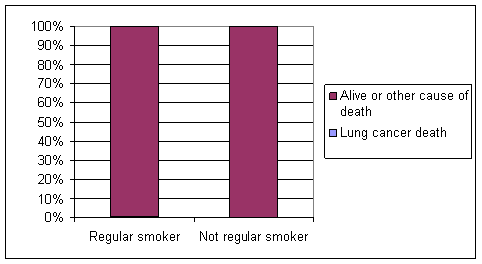
(m) Results will vary, probably less than .01.
(n) Since we get a difference between the group means as large as 15.92 in less than 1% of randomizations by chance alone, this provides strong evidence that there is some other difference between the two groups.
(o) Since this was a randomized experiment, we can attribute the difference between the two groups to the sleep deprivation on that first evening.
(p) C(21,11) = 352,716
(q) Distribution looks similar.
(r) 2533/352716 = .0072, should be close to the simulated p-value.
Investigation 2.2.2:
More Sleep Deprivation
(a) The variability in performance scores as exhibited by the widths of the boxes.
(b) Calls for prediction.
(c)-(d) Example results:
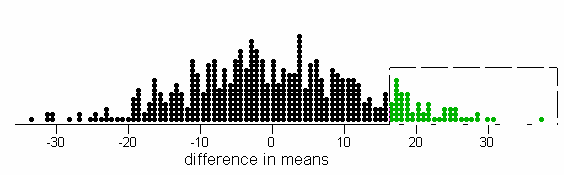
p-value » .112, much larger than for the actual experiment.
(e) These hypothetical data provide much less evidence of a significant difference between the two groups. With the larger variation within the groups, the difference in group means observed does not appear as surprising.
Investigation 2.2.3: Lifetimes of Notables
(a)
|
|
Minimum |
Lower quartile |
Median |
Upper quartile |
Maximum |
|
Writers |
29 |
60 |
66 |
78.5 |
90 |
|
Scientists |
48 |
62.5 |
76 |
86.5 |
94 |
(b) The lifetimes of the scientists tend to be longer (every number in the five number summary is larger and the mean is lifetime is 73.25 compared to 66 years for the writers). The lifetimes of scientists also tend to be more variable (IQR = 24 vs. 18.5 years) though the writers do have a few more of the extreme low values (standard deviations are more similar at 14.18 years for the scientists and 16.57 years for the writers). The distribution for the writers has a slight skew to the left while the distribution of these scientists appears a bit more symmetric.
(c) This was an observational study. The researchers did not impose the occupations on these subjects.
(d) Observed difference in mean lifetimes: 73.25-66.00 = 7.25
Observed difference in median lifetimes: 48-29=19
(e) Example results:
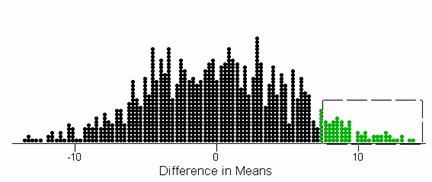
empirical p-value » .06, .07
The randomization distribution is symmetric around zero and the observed difference in means of 7.25 occurs less than 10% of the time.
(f) While there is some evidence it is not extremely strong. If we used 5% as our “cut-off” value, then we would not say the observed difference in means was statistically significant.
(g) No, since this was an observational study we cannot conclude that the occupation is what led to the difference in mean lifetimes observed between these groups.
CHAPTER 3
Investigation 3.1.1:
Sampling Words
(a) Results will vary.
(b) Length of word is quantitative and whether or not the word is “long” is categorical.
(c) We suspect that the samples will tend to overrepresent the longer words.
(d) Results will vary but the observational units are the words and the horizontal axis should be labeled “length” or “number of letters” or such.
(e) Results will vary but the observational units are the words.
(f) statistic since it is calculated for a sample, 
(g) statistic since it is calculated about a sample, 
(h) parameter, m
(i) 99/268 = .369, parameter, p
(j) no, no
(k) Results will vary, we suspect that a large percentage of the sample means will lie above 4.29.
example results

(l) Results will vary, we suspect that a large percentage of the sample proportions will lie above .369.
example results

(m) results will vary
(n) results will vary
(o) No, the sampling method will tend to overrepresent the longer words. We see evidence of this in the fact that the distribution lies to the right of the parameter value instead of being centered around the parameter value.
(p) No, longer words will still have a higher probability of being landed on.
(q) Assigning each word a number and randomly selecting the numbers.
(r) results will vary
(s) results will vary
(t) results will vary but the distributions should not center around the parameter values.
example results:


(u) no; no; now centered at the parameter value
(v) should be about half
(w) yes
Investigation 3.1.2:
Comparison Shopping
(a) The observational units are the products, the sample is the 30 items selected, the population is all products common to both stores (or all the items on the inventory list).
(b) Number the items from 01 to N = number of items on the inventory list and then randomly choose 30 numbers and find the corresponding products on the inventory list.
(c) Will take some time to find the products in the stores.
(d) A little easier to identify the sample of 30 items but will still take time to find them in the store.
(e) Randomly select a sample of items, then in each aisle, flip a coin to decide right or left, then randomly select a shelf, and then number all the 2 foot sections and randomly select a two foot section.
(f) Yes, through the sampling method we know exactly where the items are located.
(g) No since items that take up more shelf space or more likely to be selected.
(h) Yes, yes since they are a different type of item and a store may choose to “specialize” in one of these but not both with respect to cheaper prices.
(i) Number all of the food items, 1 to N, and then randomly select 22 products. Then number all of the non-food items, 1 to M, and then randomly select 8 products.
Investigation 3.1.3:
Sampling Words (cont.)
(a) Population = all words in the
(b) C(268, 5) = 1.11´1010
(c) Population is skewed the right. The mean is m = 4.29 letters and the standard deviation is 2.12 letters.
(d) Results will vary.
(e) Results will vary.
(f) Results will vary. Probability is 1/(1.11´1010).
(g) (1
+ 2)/2
should equal the value displayed by the red arrow.
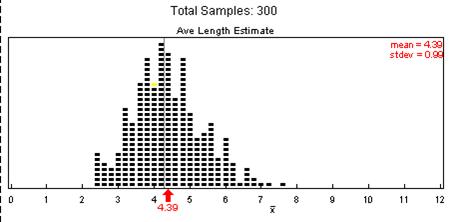
(h) observational units are the samples, the variable is the sample mean, the shape is slightly skewed to the right, the center should be around 4.29 letters, the standard deviation should be around 1 letter. There may be 1 or 2 visual outliers. For example:
(i) The different simulations should all lead to very similar pictures.
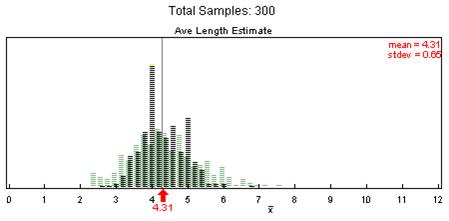
(j) The distribution of sample means should be less skewed and less spread out, with center still around 4.29 letters. For example:
(k) Yes
(l) Can try to visually judge from the graph what percentage of sample means are larger. Probably won’t be too many.
(m) Yes, there are very few sample means above 6 in the above simulation.
(n) No, a sample mean of 4.8 is closer to the mean of the sampling distribution.
(o) This would be even less surprising with the smaller sample size. In fact, Scott’s 6.7 has 2 or 3% of samples falling above it.
(p) n=10: Scott: z » (6.7-4.29)/.65 = 3.71; Kathy: z » (4.8-4.29)/.65=.785;
n = 5: Scott: z » (6.7-4.29)/.99 = 2.43; Kathy: z » (4.8-4.29)/.99 = .52
Scott with n = 10 has the largest z score.
Investigation 3.1.4:
Sampling Words (cont.)
(a) Since they are random samples, the results should be unbiased and the sample proportions should center around the population proportion p = .369. The distribution of sample proportions is the sampling distribution.
(b) The distribution will be less spread out if the samples are larger.
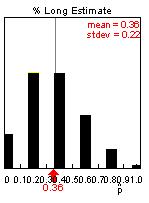
(c) The sampling distribution should appear skewed to the right with a mean of approximately .37 and a standard deviation around .22. For example:
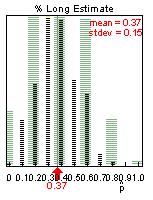
(d) The shape should appear more symmetric, with a mean of approximately .37 and a standard deviation around .15. For example:
(e) C(268, 5) = 1.11´1010 so the probability of any particular sample occurring is 1.11´10-10. Since there are 99 long words in the population, there are C(99,5) = 71,523,144 samples containing 5 long words.
(f) .0064
(g) Yes, we are selecting a random sample from a finite population of successes (long words) and failures (short words).
(h) The distribution appears slightly skewed to the right and should look very similar to the empirical sampling distribution.
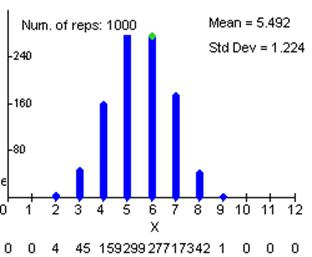
(i) E(X) = .369, which is the same as the center of the empirical sampling distributions.
(j) When n = 10
(k) E(X) = .369
(l) The exact and empirical sampling distributions should be very similar.
(m) The distribution is less skewed and less spread out but has the same center.
(n) P( = 1) = .000035. This is much smaller than the probability in (f) as it is even
less likely to find all long words in a sample of 10 than in a sample of 5.
= 1) = .000035. This is much smaller than the probability in (f) as it is even
less likely to find all long words in a sample of 10 than in a sample of 5.
(o) Hypergeometric with N = 268,
M = 50, and n = 10
x P( X <= x )
1 0.413559
This would not be a surprising
outcome.
(p) Hypergeometric with N = 268,
M = 50, and n = 10
x P( X <= x )
4 0.977636
So P(X>5) = 1-P(X<4)
= 1-.9776 = .0224. This small
probability indicates that it would be a bit surprising to obtain a sample with
5 or more nouns if only 18.7% of the words in the population were nouns.
Investigation 3.1.5:
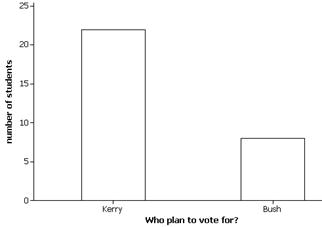
Freshman Voting Patterns
(a) The observational units are the
freshmen, the variable is whether they planned to vote for Kerry or Bush
(categorical and binary).
(b) The sample is the 30
respondents, the population is the 705 first-years on campus, and the sampling
frame is the list of residence halls, and then the rooms within the residence
halls.
(c) This was a multistage systematic
sampling plan since they randomly chose dorms, then rooms within dorms (every 7th
room). This method should be unbiased
but since they only selected one dorm they do need to be cautious that students
in that dorm do not feel tremendously different on this issue than students in
the other dorms (which seems like a plausible belief).
(d) The surveys were anonymous and
confidential and the names of the candidates were rotated.
(e)
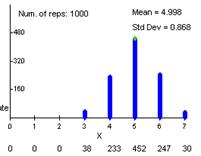
The sample reveals that most
students (73%) planned to vote for Kerry.
(f) Hypergeometric with N = 750, M = 352, and n =
30
x P( X <= x )
21 0.997414
The probability of 22 or more
freshmen indicating Kerry, if 50% of the population planned to vote for Kerry,
would be 1-.9974 = .0026. This indicates
that about .26% of random samples would yield a result this extreme if Kerry
and Bush were equally preferred in the population. This provides strong evidence that the claim
about the population is incorrect.
(g) Hypergeometric with N = 750, M = 500, and n =
30
x P( X <= x )
21 0.718464
The probability of 22 or more
freshmen indicating Kerry, if two-thirds of the population planned to vote for
Kerry, would be 1-.7185 = .2815. This
indicates that about 28% of random samples would yield a result this extreme if
two-thirds of the population planned to vote for Kerry. Thus, such a sample result would not be
surprising.
(h) It appears to be more plausible
that p
= 2/3 than .50.
Investigation 3.2.1: Do
Pets Look Like Their Owners?
(a) Answers will vary
(b) If just guessing, the probability is 1/3 that will match the correct pet with this owner.
(c) Would be the same for everyone.
(d) No, the responses are independent.
(e) Y has a Bernoulli distribution with p = 1/3. P(Y=1) = 1/3 and P(Y=0) = 2/3.
(f) Answers will vary.
(g) Answers will vary.
(h) 1(1/3) + 0(2/3) = 1/3. Should be similar (if people in class were just guessing).
Investigation 3.2.2: Pop Quiz!
(a) Answers will vary.
(b) Answers will vary.
(c) Success = answering the question ‘correctly’
Failure = not matching the stated answer.
p = ¼ for all 5 questions
the responses to the questions are independent
(d) X = 0, 1, 2, 3, 4, 5
X will vary from person to person
(e) Answers will vary
(f) number of students with one correct / total number of students
(g) Results will vary. For example:
Shape will be skewed to the right with a center of about 1.25.
(h) No, guessers are more likely to get 0, 1, or 2 correct answers than 3 or 4.
(i) There are 32 possible arrangements.
(j) No since we are more likely to get a failure than a success, outcomes like FFFSS are more likely than outcomes like SSSFF.
(k)
SSSSS SSSSF SSSFS SSFSS SFSSS FSSSS
5 4 4 4 4 4
SSSFF SSFSF SFSSF FSSSF SSFFS SFSFS FSSFS SFFSS FSFSS FFSSS
3 3 3 3 3 3 3 3 3 3
FFFSS FFSFS FSFFS SFFFS FFSSF FSFSF SFFSF FSSFF SFSFF SSFFF
2 2 2 2 2 2 2 2 2 2
FFFFS FFFSF FFSFF FSFFF SFFFF FFFFF
1 1 1 1 1 0
(l) P(FFSFF) = (3/4)4(1/4) = .0791
(m) No, are 5 ways to have just 1 success
(n) All 5 outcomes with 1 success have probability .0791 of occurring.
(o) P(X = 1) = 5(.0791) = .3955
(p) P(2 successes) = (1/4)2(3/4)3 = .0265
P(X = 2) = 10(.0265) = C(5,2)(.0265) = .2637
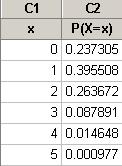
(q)
|
Number of correct answers, x |
0 |
1 |
2 |
3 |
4 |
5 |
|
Probability, P(X=x) |
0.237305 |
.3955 |
.2637 |
0.087891 |
0.014648 |
0.000977 |
(r) Since all of the probabilities are nonnegative and they sum to one, this is a legitimate probability distribution.
(s) They should be similar.
(t) P(X = x) = C(n, x) px(1-p)n-x for x = 0, 1, 2, …, n
(u) Binomial with n = 5 and p =
0.25
x P( X = x )
1 0.395508
(v)
(w)
The graph is skewed to the right with a peak at x=1. E(X) = 1.25 indicating that if we were to average the number of correct answers over many many trials, the average will converge to 1.25 correct answers.
(x) P(
> .5) = P(X >
3) = 1 – P(X < 2)
Binomial
with n = 5 and p = 0.25
x P( X <= x )
2 0.896484
The student will get 3 or more correct answers with probability 1-.8965 = .1035.
(y) P(
> .5) = P(X > 8)
= 1- P(X< 7)
Binomial
with n = 16 and p = 0.25
x P( X <= x )
7 0.972870
The student will get 8 or more
correct answers with probability 1-.9729 = .0271.
This probability is smaller. If someone is just guessing, we expect them
to get the correct answer 25% of the same.
Getting “lucky” and getting more than 50% correct answers should be less
likely as we decrease the number of questions.
With more questions, the relative frequency of correct answers should
get closer and closer to .25.
(z) P(X < k-1) > .95
Binomial
with n = 10 and p = 0.25
x P( X <= x ) x P(
X <= x )
4 0.921873 5
0.980272
(aa) If we choose the 5, the P(X < 5) > .95 and P(X > 6) < .05.
(bb) This corresponds to = 6/10 = .60
Investigation 3.3.1:
Water Oxygen Levels
(a) water samples
(b) Most like a systematic random sample with the observations coming at fixed intervals in time.
(c) The sample should be representative of the river during this time. Might be a little cautious a bout generalizing to too broad a period of time.
(d) Yes, if we consider p to be the probability of a non-compliant measurement and we are assuming the measurements are independent.
(e) p < .10
(f) C is counting the number of successes with a fixed probability of success (p = .10) for a finite number of independent trials (n = 10).
(g) = 4/10 = .40, statistic
(h) Yes, this proportion could differ from .10 by random chance.
(i) E(X) = 10(.1) = 1 day
The sample result (4 days) is larger than the expected result which is the direction conjectured by the researchers (more non-compliant days)
(j) P(C > 4) = 1- P(C< 3)
Binomial
with n = 10 and p = 0.1
x P( X <= x )
3 0.987205
P(C > 4) =1-.9872 = .0128
It is rather surprising (probability .0128) to find a sample of 10 days with at least 4 non-compliant days if we are sampling from a process with p = .10.
(k) P(C > 3) = 1- P(C< 2)
Binomial
with n = 10 and p = 0.1
x P( X <= x )
2 0.929809
P(C > 3) = 1 - .9298 = .0702.
This is also surprising but not as surprising. If we use .05 as a cut-off value this would not be convincing evidence of a problem.
(l) P(C > 19) = 1- P(C< 18)
Binomial
with n = 34 and p = 0.1
x
P( X <= x )
18 1.00000
P(C > 19) = 1- 0 » 0
It would be virtually impossible to find 19 or more non-compliant days if we are sampling from a process with p = .10. This provides very strong evidence that p > .10 for this river at this time.
Investigation 3.3.2:
Heart Transplant Mortality
(a) Could consider the heart transplantation process at this hospital.
(b) p = the probability of a heart transplantation resulting in death at this hospital
(c) p = .15
(d) p > .15
(e) Ho: p = .15 (the death rate at this hospital is higher than the national rate), Ha: p > .15
(f) = 8/10 = .80 which is indeed larger than .15.
(g) We have success (death) and failure (not death) for a fixed number of trials (n=10) where we are assuming the probability of success is constant (p = .15) for the 10 independent measurements (outcome of one patient does not affect the probability of success for the next patient).
(h)
E(X) = np = 10(.15) = 1.5 deaths
(i) P(X >
8) = 1- P(X< 7)
Binomial
with n = 10 and p = 0.15
x P( X <= x )
7 0.99999
P(X > 8) = 1- .99999 = .00001
(j) It is very surprising to find 8 or more deaths with sampling from a process with p = .15. We would expect such a result in .001% of samples from this process.
(k) P(X > 71) = 1- P(X < 70)
Binomial
with n = 361 and p = 0.15
x
P( X <= x )
70 0.990303
P(X > 71) = 1-.9903 = .0097
(l) With a p-value below .01 we
would reject the null hypothesis and conclude that p, the
probability of a death, is higher than .15 for this hospital.
Investigation 3.3.3:
Do Pets Look Like Their Owners (cont.)
(a) Since the outcomes (success = match owner with dog) for the 28 judges will be independent and everyone has a .5 probability of guessing correctly, X will be binomial with n = 28 and p = .5.
(b) P(X > 15) = 1- P(X < 14)
Binomial
with n = 28 and p = 0.5
x
P( X <= x )
14 0.574723
P(“match”) = 1-.5747 = .4253
(c) Since the outcomes (success =
group match) for the 45 owners will be independent and each owner has a .4253
probability of being matched, Y will
be binomial with n = 45 and p = .4253.
(d) E(X) = 45(.4253) = 19.1 match
(e) Parameter, let p = probability of the judges matching the owner with the correct dog.
H0: p = .4253 (probability that the panel matches the dog if just guessing)
Ha: p > .4253 (higher probability of a match than just guessing)
p-value = P(Y > 23) = 1 – P(Y< 22)
Binomial
with n = 45 and p = 0.4253
x
P( X <= x )
22 0.844587
p-value = 1-.8446 = .1554
With such a large p-value (.1554
> .05), we fail to reject the null hypothesis.
Our conclusion is that, while the
judges did better than expected, they did not perform significantly better than
we would expect if they were guessing randomly.
(f) p-value = P(Y > 16) where Y
is binomial with n = 25 and p = .4253.
Binomial
with n = 25 and p = 0.4253
x
P( X <= x )
15 0.974944
p-value = 1-.9749 = .0251
At the .05 level of significance,
p-value < .05, so we can reject the null hypothesis.
There is convincing evidence at the
5% level that the judges were able to correctly match more of the pure-bred dogs
than we would expect by chance if they were just guessing.
Investigation 3.3.4:
Halloween Treat Choices
(a) The observational units are the
treat-or-treaters. The variable of
interest is which treat they choose (categorical, possible outcomes = toy or
candy).
(b) Let p = probability
of a child choosing the toy (arbitrarily treating a toy as a success)
(c) p = .5 (null)
(d) would expect half or 142 of the
children to choose the toy
(e) 135 is fewer children than
expected
(f)
(g) 135 is 7 below the expected 142
(h) P(X > 149):
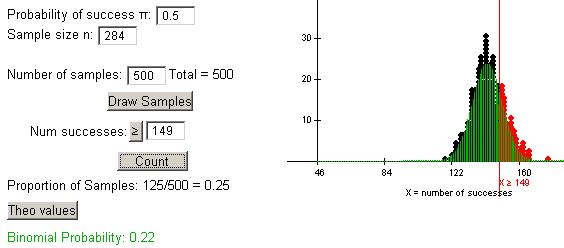
(i) two-sided p-value = .44, this is
not statistically significant at the .05 level.
Investigation 3.3.5:
Kissing the
(a) The observational units are the
kissing couples and the population appears to be all kissing couples in these
public areas in these countries (and perhaps even broader). Since there was nothing special about how
the couples were identified, we can consider this a representative sample of
the kissing in public process.
(b) If we assume the behavior of the
couples are independent and that the probability of success (turning to the
right) is constant across the couples (helped by not having them dealing with
luggage etc.) then X is binomial with
n = 124 and p = probability of
kissing couple turning to the right.
(c) H0: p = .5 (equally
likely to turn right and left)
Ha: p ≠ .5 (not
equally likely) – answers will vary
(d) H0: p = .5 (equally
likely to turn right and left)
Ha: p > .5 (more
likely to turn to the right)
p-value » 0
With such a small p-value we will
reject the null hypothesis.
There is strong evidence that
couples are more likely to turn to the right than to the left.
(e) H0: p = 2/3 (2/3 of
couples will turn to the right)
Ha: p ≠ 2/3
(the probability of turning to the right differs from 2/3)
p-value = .633.
We would fail to reject H0.
The probability of turning to the
right is not significantly different from 2/3.
Investigation 3.3.6:
Kissing the
(a) Best guess would be 80/124 =
.645
(b) While we think p should be close
to the observed proportion of successes, we know due to sampling variability
that it is probably not exactly .645.
(c) The largest value of p is .72
The smallest value of p is .56
Any value of p between
(including) .56 and .72 lead to two-sided p-values above .05.
(d) More values of p would now
“qualify.”
(e) Exact
Sample X
N Sample p 95% CI P-Value
1 80
124 0.645161 (0.554230,
0.728983) 0.002
Minitab reports a 95% confidence
interval from about .55 to .73.
(f)
Test
of p = 0.667 vs p not = 0.667
Exact
Sample X
N Sample p 95% CI P-Value
1 80
124 0.645161 (0.554230, 0.728983) 0.634
(g)
Test
of p = 0.5 vs p > 0.5
95%
Lower Exact
Sample X
N Sample p Bound
P-Value
1 80
124 0.645161 0.568368
0.001
Investigation 3.3.7:
Improved Batting Averages
(a) Ho: p = .250 (player
is still a .250 hitter)
Ha: p > .250
(player is trying to show his average has increased)
(b) X is binomial since the at-bats will be independent, there are 20
of them, and we are assuming the probability of success (getting a hit) is the
same for every at bat.
(c) There is a fair bit of overlap
in the two distributions indicating that it is difficult to tell a .250 hitter
and a .333 hitter apart in 20 at-bats.
The player could have a tough time demonstrating his improvement.
Example output:
(d) X > 9
Example output:
(e) From above example output: .048
(f) From above example output: .187
(g) Need x < 8 or x >
9
(h) P(X > 9) = 1- P(X
< 8)
Binomial
with n = 20 and p = 0.333
x P( X <= x )
8 0.810338
1-.8103 = .1897 (very similar to the
applet value)
(i) If the player gets 7 hits, this
is less than 9, so the manager would not be convinced of the player’s
improvement. This is a mistake since the
player is actually a .333 hitter.
(j) Type I Error: Think the player
has improved when he has not
Type II Error: Think the player has
not improved when actually he has
(k) P(Type I Error) » .048
P(Type II Error) = .81
(l) power = 1-.81 = .19
(m) The player would prefer the type
II error has a small probability (failing to see his improvement). The owner would prefer the type I error has a
small probability (falsely thinking the player has improved).
(n) To reduce the probability of a
Type I error, we need to raise the standard for improvement to 10.
(o) From example output below:
empirical level of significance (prob of type I error) is down to .016 and
probability of a type II error is now 1-.083 = .917
(p) more at-bats
(q) yes, as the unimproved player
will be less likely to get “lucky” and the improved player will be less likely
to get “unlucky”
(r) The distributions are now more
clustered around their own respective means.
(s) Rejection region: X > 34
(t) Type II error = 1-.449 = .551,
much smaller than before, and power = .449, much larger than before.
(u) Yes, there is now a higher
probability that the player will be able to demonstrate that improvement.
(v) Rejection region: X > 37
probability type II error = .785
this change helped the manager but
hurt the player
(w) should be easier to demonstrate
that he is not a .250 hitter.
(x) Less overlap in the
distributions.

P(Type I Error) still about .045
P(Type II Error ) = .565, less than
in (k)
(y)

(z) If P(Type I Error) decreases,
then P(Type II Error) increases and vice versa.
But the owner prefers small P(Type I Error) while the player prefers
small P(Type II Error). The level of
significance controls P(Type I Error).
Increasing the sample size and increasing the alternative probability
away from .250 both decreased P(Type II Error).
Investigation 3.4.1:
Sampling Words (cont.)
(a) 99/268 = .369
(b) yes, yes
(c) 98 long, 169 short
(d) P(also long) = 98/267 = .367,
this is reasonably similar to the previous probability
(e) P(5th also long) =
95/264 = .3598
(f) not hugely different
(g) 49/218= .225, now we are looking
different.
(h) Yes since 268 > 20(5) = 100, n = 268, p = .369
(i)
Binomial
with n = 5 and p = 0.369
x P( X = x )
5 0.0068412
This probability, .0068, is close to
the exact probability .0064.
(j) Yes since 268 > 20(10) = 200.
(k)

These probabilities look pretty
similar.
(l)
Row x
binom hyper
5
4 0.000003 0.000000
6
5 0.000015 0.000003
7
6 0.000064 0.000015
8
7 0.000234 0.000070
9
8 0.000737 0.000271
10
9 0.002011 0.000900
11
10 0.004821 0.002576
12
11 0.010251 0.006412
13
12 0.019483 0.013998
14
13 0.033303 0.026969
15
14 0.051470 0.046087
16
15 0.072238 0.070163
17
16 0.092408 0.095499
18
17 0.108078 0.116565
19
18 0.115871 0.127910
20
19 0.114122 0.126447
21
20 0.103442 0.112801
22
21 0.086417 0.090932
23
22 0.066615 0.066308
24
23 0.047424 0.043772
25
24 0.031199 0.026171
26
25 0.018975 0.014176
27
26 0.010669 0.006957
28
27 0.005546 0.003092
29 28 0.002664
0.001244
30
29 0.001182 0.000453
31
30 0.000484 0.000149
32
31 0.000183 0.000044
33
32 0.000063 0.000012
34
33 0.000020 0.000003
35
34 0.000006 0.000001
36
35 0.000002 0.000000
Not looking so similar any more.
Investigation 3.4.2:
Feeling Good
(a)
sample of adults in the
(b)
population is adults in the
(c) answers will vary, parameter
(d) the same as the answer to (c)
(e)
yes since the
(f) Answers will vary depending on guess and direction of Ha. Should use the binomial approximation.
(g) Type I Error: Thinking the population proportion is larger/smaller/different than my guess when it actually isn’t.
Type II Error: Thinking the population proportion is equal to my guess when it is actually larger/smaller/different.
If you rejected H0, then it’s possible are committing a Type I Error. If failed to reject Ho, is possible are committing a Type II Error.
(h) Values between .858 and .899 would not be rejected.
(i) Exact
Sample X
N Sample p 95% CI P-Value
1 895
1017 0.880039 (0.858472,
0.899377) 0.000
We are 95% confident that between 85.8% and 89.9% of American adults feel good about the quality of their life overall. If you rejected your guess, then it would not be contained in the confidence interval.
Investigation 3.4.3:
Long-Term Effects of Agent Orange
(a) observational study since they didn’t randomly select which people to the agent orange.
(b)
residents of
(c) No but assume it’s rather large
(d) Yes if the population in (b) is much larger than 43
(e) H0: p = .5 (half of residents have elevated levels)
Ha: p > .5 (more than half of residents have elevated levels)
Test
of p = 0.5 vs p > 0.5
95%
Lower Exact
Sample X
N Sample p Bound
P-Value
1 41
43 0.953488 0.860731
0.000
With
such a small p-value (< .001) we have very strong evidence to reject H0
and conclude that more than half of all current residents in
(f) If p = .5, that would indicate that the median was equal to 5 ppt.
CHAPTER 4
Investigation 4.1.1:
Potpourri
(a) All of the distributions are reasonably symmetric without many outliers.
(b) The center and spread differ across the distributions.
(c) Same shape but vertical axis has been scaled.
(d) The total area represented is one.
(e) It has some resemblance to the overall pattern.
(f) The normal probability curve provides a reasonable model for all 8 variables.
Investigation 4.1.2:
Body Measurements
(a) The normal distribution provides a reasonable model for these data.
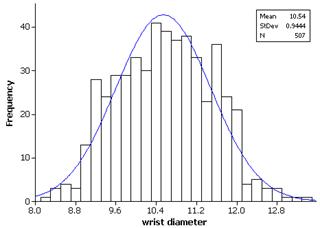
(b)
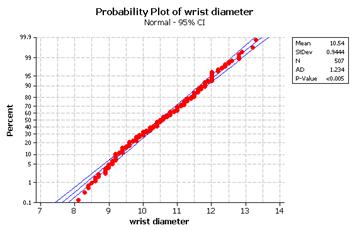
(c) The small wrist diameters appear to deviate slightly from the linear pattern. This is also seen by those bar heights being consistently lower than the normal curve in the histogram.
(d) The graphs indicate that the lower weights are smaller than we would expect them to be (shorter left tail).
(e) The graphs indicate that the smaller diameters are even smaller than we would expect them to be (a longer left tail).
(f) The graphs indicate two mounds in the distribution, perhaps due to gender differences.
(g) The genders look fairly normal when graphed separately. The female girths appear slightly skewed to the right. The male girths show a very slight skew to the left.
(h)-(i) The histograms should all look reasonably normal and the normal probability plots should look reasonably straight (large p-values).
(j) It will be difficult to judge the shape in the histograms with such small samples, but the normal probability plots should still look roughly linear, but with lots of variation.
Investigation 4.2.1:
Fuel Capacity
(a) mean = 16.38, std dev = 2.708
(b) Between 16.38-2.71 and 16.38+2.71 = 13.67 and 19.09
(c) 74/108 or 68.5% of the values are in this range as predicted by the empirical rule (68%)
(d) estimates will vary
(e)
Normal
with mean = 16.38 and standard deviation = 2.708
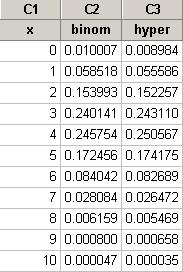
x
P( X <= x )
13 0.105987
probability ≈ .106
(f) If we were to repeatedly sample
cars from this population, we would find a fuel capacity below 13 gallons about
10.6% of the time.
(g) 11/108 or 10.2%, pretty close to
what we predicted!
Investigation
4.2.2: Body Measurements (cont.)
(a) Answers will vary
(b) Yes, both appear reasonably
normal but they differ in the centers of the distributions.
(c) A height of 185 would be
surprising for a female but not for a male.
(d)
(f)
x
P( X <= x )
185 0.998925
(g) The total area under the curve
is one and P(X>185) = 1-P(X< 185) = 1-.9989 = .0011.
(h) 1- P(X<185) = .8454 = .1546
Normal
with mean = 177.7 and standard deviation = 7.18
x P( X <= x )
185 0.845355
(i) z (female) = (185-164.9)/6.55 =
3.07
z (male) = (185-177.7)/7.18 = 1.02
The female z-score is higher than the male z-score
as a height of 185 is further from the female mean than the male mean.
(j)-(l) Both distributions look
reasonable normal with mean 0 and standard deviation 1.
(m) 1-.9987 = .0013
(n) 1-.8461 = .1539
These are essentially the same (just
differ due to rounding)
(o) z=(151.8-164.9)/6.55 = -2.00
prob below » .02275
(p) .02275 corresponds to a z of about -2.00. To be at least 2 standard deviations below
the mean, a male would have to be 177.7-2(7.18) = 163.3 cm or shorter.
(q) z = -2.00 in both.
Investigation 4.3.1:
Reese’s Pieces
(a) Yes, we are counting the number of successes (orange candy) in a fixed number (25) of independent trials.
(b) No, the actual outcome of X will vary from student to student.
(c) Statistic, results will vary.
(d) Results will vary
(e) No
(f) Should be symmetric, with mean near 11-12.
(g) Yes, with mean about 11-12 and standard deviation about 2.5.
(h) The horizontal axis would scale so the center is around .45-.50 and the standard deviation is around .1.
(i) The actual values of will probably differ but the applet will
report the average and the standard deviation of the values of that you obtain. The values of the pht’s will generally vary
from sample to sample.
(j) Shape should be pretty symmetric, center should be around .45, std dev should be around .1
(k) Should match fairly well.
(l) 68%, 95%, 99.7%
(m) answers will vary
(n) should be fairly close
(o) less variable
(p) normal model still appropriate, std dev now much smaller, above 90% will be within + .10.
(q) predictions will vary
(r) will now center around .75
(s) more spread out. Might also notice that the normal approximation is no longer all that reasonable.
Investigation 4.3.2:
Reese’s Pieces (cont.)
(a) E(X) = np = 25(.45) = 11.25 candies (on average, in the
long-run)
(b) 11.25/25 = .45
(c) E(X/n) = (1/n)E(X) = (1/n)(np) = p
(d) SD()
= SD(X/n) = |1/n|SD(X) = (1/n)
(e) E()
= .45, applet results should be similar
SD()
= .0995, applet results should be similar
(f)
(g) mean = .45, std dev = sqrt(.45*.55/75) = .0574
P( > .75):
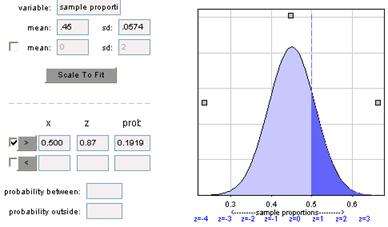
This probability is much smaller as we would expect the sample proportion to be closer to .45 with the larger sample size.
(h)
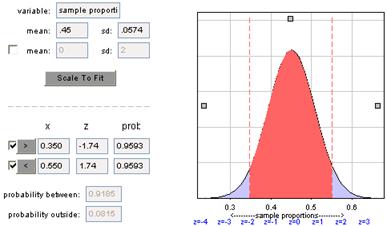
The sample proportion will be between .35 and .55 in about 92% of samples.
Investigation 4.3.3: Cohen v.
(a) observational units: student athletes;
population/process: determination of gender of athletes; parameter: p = probability of a
(b) H0: p = .51 (probability that an athlete is female is the same as the proportion of females at Brown)
H0: p < .51 (women are underrepresented among the athletes)
(c) Check np = 897(.51) = 457.5 > 10 and n(1-p)=897(.49)=439.5 > 10 and, since we are treating this as a random sample, the conditions for the Central Limit Theorem to apply are met.
(d) z = (.38-.51)/sqrt(.51*.49/897) = -7.79 so that the observed sample proportion is almost 8 standard deviations below the conjectured value.
(e)
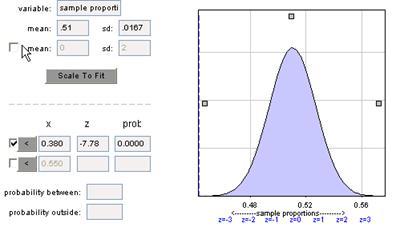
The p-value is very small.
(f) We have very strong evidence that the small sample proportion did not result by chance from a process with p = .51. The sample proportion is significantly lower than .51.
Investigation 4.3.4:
Kissing the
(a) With n = 124
and p0 = 2/3, we have np =124(2/3) = 82.7 and n(1-p) =
124(1/3) = 41.3. If we consider this a
random sample then the Central Limit Theorem applies.
(b) SD = .0423
(c) z = (.645 - .667)/.0423 = -.516
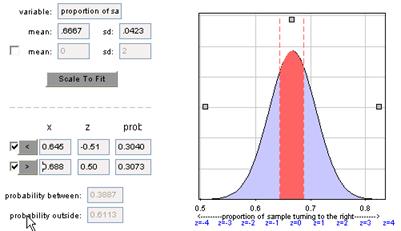
We want the probability outside: .6113 (answers will vary a bit depending
on the rounding of 2/3).
We fail to reject H0 at the 5% level.
We do not have significant evidence that p differs
from .667.
(d) This two-sided p-value is fairly similar to what we
obtained before.
(e) A test statistic of -.51 indicates that the observed sample proportion (.645) is about .5 standard deviations below the conjectured value of .6667.
(f)
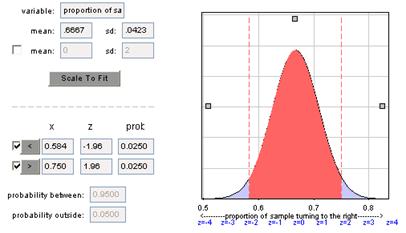
For the two-sided p-value to be below .05, we need the test statistic to be approximately -1.96. This corresponds to a sample proportion of .667 – 1.96(.0423) = .584
(g) .667 + 1.96(.0423) = .75
(h)
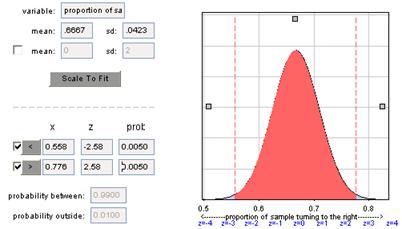
Now need to be 2.58 standard deviations from the mean, .558 - .776. These cut-offs are more extreme as expected as the lower level of significance requires more extreme evidence.
(i) .05, type I
(j) If p = .5, the sampling
distribution of the sample proportion will be centered at .5 with standard
deviation .0449. So we need to find P( < .584) . Note P( > .750) » 0.
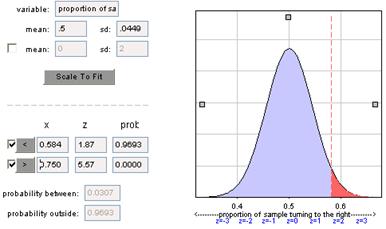
So the probability is .9693 that will fall < .584 (or above .750) and
we will reject H0: p = 2/3.
(k) .01, type I;

P( < .558 or > .750 when p =
2/3) = .01
P( < .558 when p =
.5) = .9015. This is smaller than
before.
(l) If we increase alpha, power increases.
If we increase the sample size, power increases
If we use .6 instead of .5, the power will decrease as it will be harder to reject p = 2/3 in favor of .6 than in favor of .5.
(m) Assuming a 5% level of significance, the cut-off (rejection region) is found by going 1.96 standard deviations below 2/3. The P(Type II Error) is then found by seeing how many standard deviations this cut-off is above .5. We want the cut-off to be about 2.33 standard deviations above .5.
.5+2.33sqrt(.5*.5/n) = .67 – 1.96sqrt(2/3(1/3)/n)
 = 2.089/.17 = 12.3
n > 152
Investigation 4.3.5: Cohen v.
(a) Should be within two standard deviations of p.
(b) within 2 standard deviations.
(c) use
(d) sqrt(.38(.62)/897) = .0162
(e) .38 – 2(.0162) and .38 + 2(.0162) = .348 and .412
(f) .975
(g) 1.96
(h) .38 + 1.96(.0162) = .348 and .412
(i) .51 is not in this range (we rejected .51 as a plausible value for p earlier).
(j) We are 95% confident that the process at
(k) z* = 2.576
.38 + 2.576(.0162) = .38 + .042 = .338 - .422
This interval is wider than the 95% confidence interval.
(l)
Sample X
N Sample p 95% CI Z-Value P-Value
1 341
897 0.380156 (0.348389,
0.411923) -7.18 0.000
Sample X
N Sample p 99% CI Z-Value P-Value
1 341
897 0.380156 (0.338407,
0.421905) -7.18 0.000
(m)


Investigation 4.3.6: Good News or Bad News First
(a) Bar graph should have one bar for good news and one for bad. Results will vary.
(b) Let p = proportion of all students at your school that prefer bad news first. Interval calculation will vary but interpretation will be that you are 95% confident that the interval captures p.
(c) Probably do not pass np >10 and n(1-p)>10.
(d) Coverage rate will be around 80%, not close to the 95% confidence level.
(e) Probably at least 95%.
(f)-(g) Calculations and summary will vary.
(h) Probably not, do you feel the statistics class is a representative sample of all students at your school?
Investigation 4.4.1: Scottish Militiamen and American Moms
(a) observational units = militiamen, variable = chest measurement (quantitative)
(b) The distribution of chest measurements for early 19th century militiamen appears symmetric with mean 39.8 inches and standard deviation 2.05 inches. If we are considering this our population, we have calculated m and s.
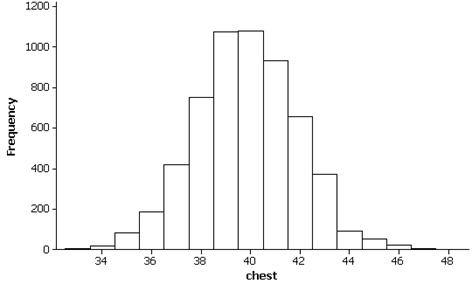
(c) Results will vary. For example:
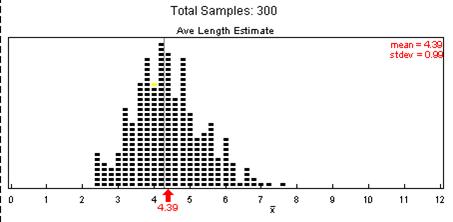
The shape will be difficult to judge with only 5
observations, the sample mean should be in the ballpark of 39.8 inches and the
sample standard deviation should be in the ballpark 2.05inches.
These are parameters and we could denote them by  and by s.
(d) The observational units are samples and the variable is the sample mean. Results will vary but the distribution of the sample means should be symmetric with mean near 39.8 and standard deviation near .9. For example:
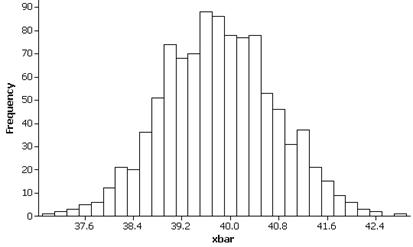
The distribution has a similar shape and center as the population but is less variable.
(e) The normal distribution does appear to be a reasonable model, e.g.,
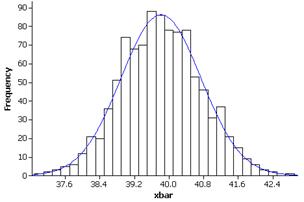
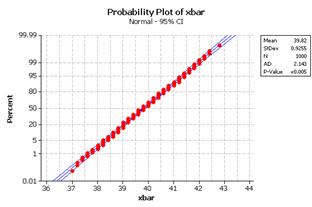
(f) The distribution of ages for this sample of mothers is skewed to the right with mean m = 22.52 and standard deviation s = 4.885
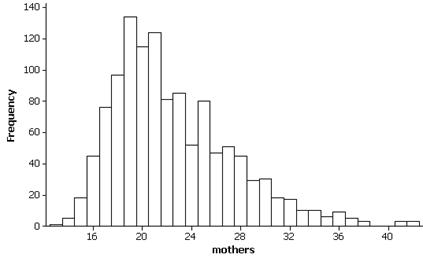
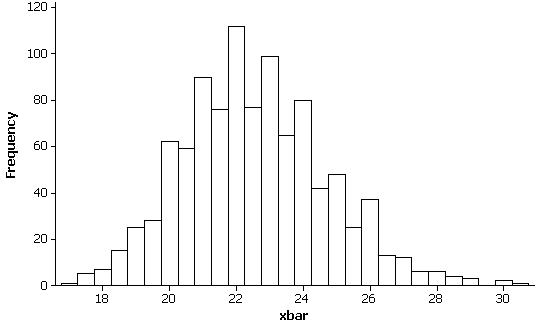
(g) Results will vary but the distribution of the sample means is less skewed than the population, with mean near the population mean of 22.52 and standard deviation of about 2.2. For example:
(h) Conjecture will vary.
(i) Results will vary but this distribution should be reasonably modeled by a normal distribution with mean near the population mean of 22.52 years and standard deviation of about .7 years. For example:
(j) This distribution is more symmetric and has less variability than the distribution with samples of size n=5.
(k)
|
Population |
Shape |
Center |
Standard deviation |
|
Normal m=39.8, s =2.05, n=5 |
Symmetric |
39.6 (m) |
.92 smaller than s |
|
Skewed m = 22.52, s=4.89, n=5 |
Slight skew to right |
22.5 (m) |
2.2 smaller than s |
|
Skewed m = 22.52, s=4.89, n=50 |
Symmetric |
22.52 (m) |
.69 much smaller than s |
(l)
|
Population |
s/ |
Simulation |
|
Normal m=39.8, s =2.05, n=5 |
.92 |
similar |
|
Skewed m = 22.52, s=4.89, n=5 |
2.2 |
similar |
|
Skewed m = 22.52, s=4.89, n=50 |
.69 |
similar |
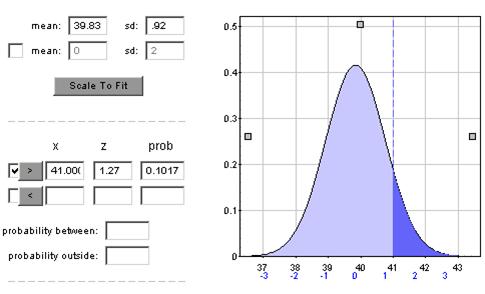
(m) P( > 41) = .10
Distribution of sample means will be normal with mean = 39.83 and standard deviation .92.
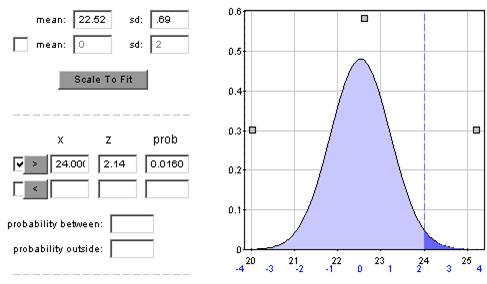
(n) Distribution of sample means will be symmetric with mean 22.52 years and standard deviation 4.89/sqrt(50) = .69 years.
(o) No, since the distribution of sample means is not predicted to be well modeled by the normal distribution.
(p) We can still conjecture that the probability will be larger since the standard deviation will be larger, 4.89/sqrt(5) = 2.2 indicating that it would be less surprising to obtain a sample mean this far from the population.
Investigation 4.4.2:
Scottish Militiamen and American Moms (cont.)
(a) + z* s/ .
.
(b) Results will vary but percentage should be close to 95%.
(c) The percentage will be less than 95%, closer to 88-90%.
(d) For example:
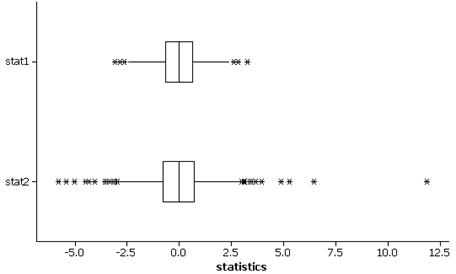
The distribution of stat1 is less variable, with shorter tails, than the distribution of stat2.
(e) The distribution of stat1 (in black) appears to be well
modeled by a normal distribution but not the distribution of stat2. 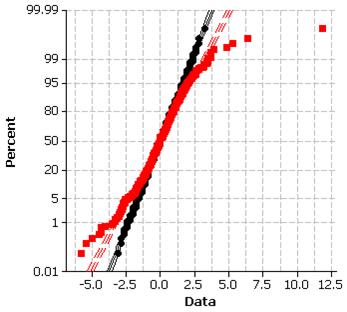
(f) The normal probability plot also reveals the longer tails in the distribution of Stat2.
(g) t* = 2.776, z* = 1.96, the t critical value is larger.
(h) The percentage should now be close to 95% though perhaps a bit smaller.
(i) Yes, since, in the long-run, 95% of intervals succeed in capturing the value of the population mean.
(j) Should be close to 95%
(k) t*49 will be smaller than t*4. In fact t*49 will be closer (but still a bit larger) than z*
(l) Should be close to 95%
(m) The widths will tend to be smaller and less variable for the larger sample size. This is because of the higher precision of our estimates (both the sample means and the sample standard deviations) with larger samples.
Investigation 4.4.3:
Basketball Scoring
(a) The distribution of total points scored is fairly
symmetric with mean = 195.88 pts and
standard deviation s = 20.27 points.
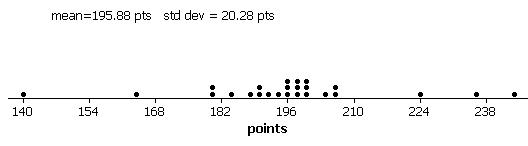
(b) Let m = average total points scores per game after the rule change.
H0: m = 183.2 (scoring did not increase)
Ha: m > 183.2 (scoring is higher on average)
(c) standardize the observation
(d) The sampling distribution of the test statistic would be well-modeled by a t distribution with 24 degrees of freedom.
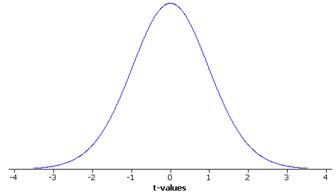
(e)-(f) n= 25 but since the sample is reasonably symmetric, it is plausible that the population distribution follows a normal distribution.
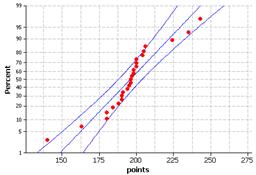
(g) Not really, these observations were recorded during the same three day period near the beginning of the season. This time period may not be representative of the season as a whole as players are still getting into playing shape and may still be adjusting to the new rule changes.
(h) t0 = (195.88-183.2)/(20.27/sqrt(25)) = 3.13
estimates will vary
(i) 1- .9977 = .0023, the p-value
(j) With a p-value < .05, we would reject the null hypothesis and conclude that the average points scored per game this season is higher than 183.2. However, we have some doubts as to the validity of this procedure since we did not a have a random sample of games and also relies an the belief that the population distribution of points scored is reasonably symmetric.
(k) t = 1.71
195.88 + 1.71(20.27/sqrt(25)) = (188.9, 202.8)
We are 90% confident that the mean points scored per game this season is between 188.9 points and 202.8 points. We cannot conclude that the rule changed caused the increase in scoring since this was an observational study.
(l) 13/25 à 52% of games fall in this interval, not close to 90% but that is not what the 90% confidence level claims
(m) No, in fact, an even smaller percentage since the interval will be narrower with the larger sample size.
(n) = 195.88
(o) s = 20.27
(p) 195.88 + 1.71 (20.27)sqrt(1+1/25) = 195.88 + 35.35
We are 90% confident that between 160.53 and 231.23 points will be scored in a game.
(q) Wider as now we are trying to predict an individual value not just the population mean.
(r) Should be close to 90% (22/25 = 88%).
(s) Test of mu = 183.2 vs >
183.2
95%
Lower
Variable N
Mean StDev SE Mean
Bound T P
points 25
195.880 20.272 4.054
188.943 3.13 0.002
(t)
Variable N
Mean StDev SE Mean
90% CI T
P
points 25
195.880 20.272 4.054
(188.943, 202.817) 3.13
0.005
(u) 95% CI for m: 190.18, 206.91
This interval is narrower than the 90% confidence interval.
(v) t = 1.71 with p-value = .0502 or t = 1.74 with p-value = .0472
So the null hypothesis would be rejected for a t-value larger than 1.71.
Investigation 4.4.4:
Comparison Shopping (cont.)
(a) observational units = grocery store products, population = products common to both stores, sample = 29 items selected. Predictions about cheaper store will vary though are told that Lucky’s advertises itself as a discount store.
(b) This was a systematic sample.
(c)
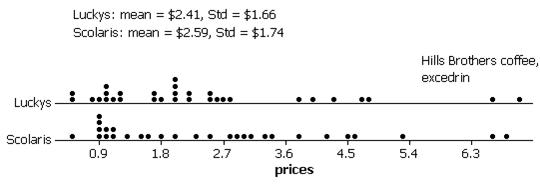
Both distributions appear skewed to the right, centered around 2.5 dollars but with similar spread. The same two products (Hill’s Brothers French Roast and Excedrin (50 tablets) appear to be outliers in both distributions.
(d) Since the same products were obtained at both stores. It makes more sense to compare the products to their counterpart at the other store.
(e) Examining the distribution of price differences.
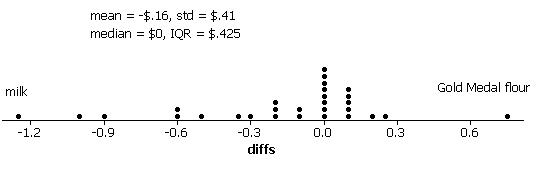
The distribution has a slight skew to the left. There is a cluster around $0 but there appears to be more products that are more expensive at Scolari’s than at Lucky’s.
(f) The outliers here are not the same as in (b). They seem to stem for the products not being exactly identical at the two stores.
(g) Yes, any where the products do not match at the two stores.
Just one item was removed, n is now 28.
(h)
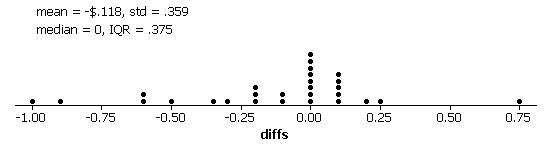
Still a small amount of evidence that there are more products that are more expensive at Scolari’s.
(i) H0: m = 0 (no tendency for one store to be more expensive)
Ha: m < 0 (on average, higher prices at Scolaris)
(j) Test of mu = 0 vs < 0
95% Upper
Variable N Mean
StDev SE Mean Bound
T P
diffs 28
-0.118214 0.358774 0.067802
-0.002728 -1.74 0.046
We would reject the null hypothesis at the 10% level (p-value = .046 < .10). There is moderate evidence that, on average, Scolari’s has more expensive products.
(k)
Variable N
Mean StDev SE Mean 90% CI
diffs 28
-0.118214 0.358774 0.067802
(-0.233701, -0.002728)
We are 90% confident that the average price difference is between .3 cents and 23 cents (more expensive at Scolari’s).
Investigation 4.5.1:
Sampling Words (cont.)
(a) E() = m = 4.29 and SD() = s/= 2.12/sqrt(10) = .670
(b) Since the population distribution is clearly skewed to the right and the sample size is small, we may suspect that the sampling distribution will not be well-modeled by a normal distribution.
(c) sample mean, = 4.80, sample
standard deviation, s = 2.15, 95% t interval, (3.26, 6.34).
We would be 95% confident that m is between 3.26 letters and 6.34 letters.
(d) Results will vary but will probably differ from the original sample mean.
(e) Results will vary from sample to sample.
(f) Results will vary. Below are the results of one such simulation.
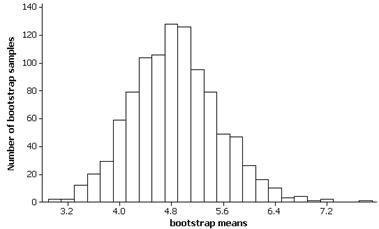
(g) Results will vary but for the above simulation, the mean
of these 1000 bootstrap means is 4.81 letters and the standard deviation is
.669 letters. The standard deviation should be close to the theoretical values
of SD( ).
).
(h) 4.80 + 2.262(.669) = (3.29, 6.31). We would be 95% confident that m is between 3.29 letters and 6.31 letters. This interval is very similar to the t interval in (c).
(i)  *.975 = 6.2
(j) *.025 = 3.5
(k) = 4.80
2-*.975 = 2(4.80)-6.2 = 3.4
2-*.025 = 2(4.80)-3.5 = 6.1
(l) We need to find *.95 and *.05 from the bootstrap distribution.
*.95 = 6.0
*.05 = 3.80
2-*.95 = 2(4.80)-6.0= 3.6
2-*.05 = 2(4.80) -3.8 = 5.8
The 90% bootstrap confidence interval would be (3.6, 5.8).
Investigation 4.5.2:
Comparison Shopping (cont.)
(a) Below are example results:
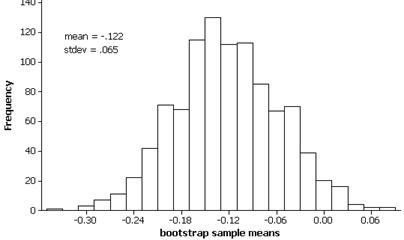
The bootstrap distribution is roughly symmetric with mean similar to the sample mean -$.118 and standard deviation approximately $.065.
(b) The 97.5th percentile value should be around .0086 and the 2.5th percentile should be around -.25. So the bootstrap percentile interval is
2(-.118 ) - .0086 = - .24
2(-.118) – (-.25) = .01
(c) This is pretty similar to a t-interval of the differences, (-.257, .021)
Investigation 4.5.3:
Treatment Time for Heroin Addiction
(a) The distribution is skewed to the right with a median of 367.5 days and an inter-quartile range of 418.5 days.
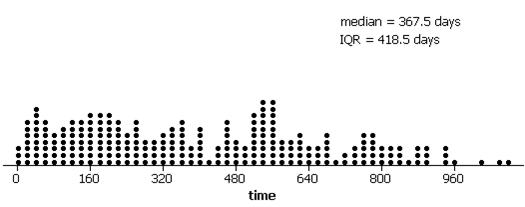
(b) An example bootstrap distribution:
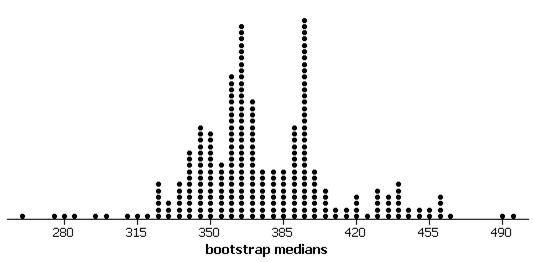
The distribution is fairly symmetric but irregular. The standard deviation is 31.55 days.
(c) The 97.5th percentile value should be around 450 and the 2.5th percentile should be around 323.5.
2(367.5) – 450 = 285
2(367.5) – 323.5 = 411.5
A 95% percentile bootstrap confidence interval for the population median is approximately 295-411.5 days.
(d) 25% trimmed mean for the sample is 376.5 days.
(e) An example bootstrap distribution:
The distribution is fairly symmetric with mean near the sample trimmed mean (376.5) and standard deviation around 22.3 days.
(f) The 97.5th percentile value should be around 421.6 and the 2.5th percentile should be around 334.1 (or so).
2(376.5) – 421.6 = 331.4
2(376.5) – 334.1 = 418.9
A 95% percentile bootstrap confidence interval for the population trimmed mean is approximately 334.8 – 419.8 days.
(g) 376.5 ± 1.97(22.29) = (332.6, 420.4)
We are 95% confident that the population trimmed mean is between 332.6 days and 420.4 days.
CHAPTER 5
Investigation 5.1.1: Newspaper Credibility Decline
(a) So that there is no bias due to the order in which the choices are presented. For example, people may have a tendency to respond more negatively toward the end of the list if they are getting tired of the survey process.
(b) observational units = respondents
variable 1= believability rating of their daily newspaper
This is an observational study since we are only surveying their opinion and not imposing any treatments. The samples are the respondents in 2002 and the respondents in 1998. The populations are everyone who could rate their daily newspaper in 2002 and 1998. We could also consider the year the explanatory variable (though again, we did not randomly assign this condition to different people in the sample) and the distribution of this variable was controlled by the study design.
(c) Two-way table:
|
|
1998 |
2002 |
Total |
|
Largely believable |
618 |
591 |
1209 |
|
Not largely believable |
922-618=304 |
932-591=341 |
645 |
|
Total |
922 |
932 |
1854 |
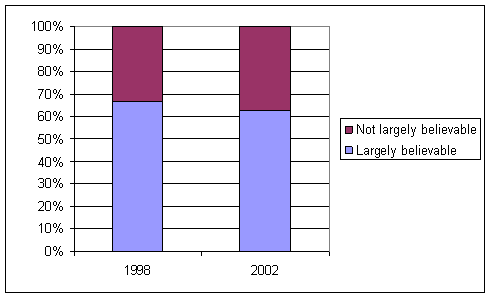
There does not appear to be a large difference in the sample proportions who rate their local daily newspaper as largely believable (.670 and .634) though a higher proportion felt it was largely believable in 1998 than in 2002.
(d) Yes, sampling variability.
(e) Yes if we take n=922 and p = proportion in population who would rate their paper as largely believable in 1998. This was a random sample so the trials (respondents) will be independent. The population is more than 20 times the size of the sample so we will consider the probability of success to be approximately constant for every member of this sample.
(f) Yes, for the same reasons in (e) with n=932 and p = proportion in population who would rate their paper as largely believable in 2002.
(g) No, Z does not count the number of successes and failures in a fixed number of trials.
(h) If there was no difference between the two years, then p1-p2 would be zero.
(i) H0: p1 – p2 = 0 (no difference in the proportion who rate the paper as large believable in these two populations)
Ha: p1 – p2 > 0 (the population proportion in 1998 is larger than the population proportion in 2002)
Note: we are assuming p1 represents 1998.
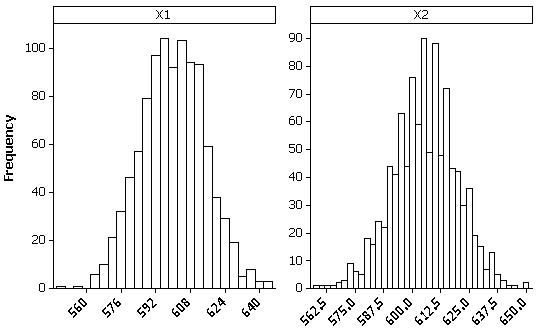
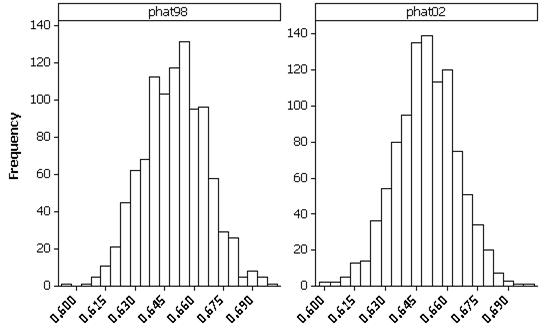
Results will vary, but the distributions should be pretty symmetric with
|
|
X1 |
|
X2 |
|
|
Mean |
599.3 |
.65 |
605.8 |
.65 |
|
Std Dev |
14.48 |
.0157 |
14.56 |
.0156 |
The values in the table are the theoretical mean and standard deviation for each distribution and should be similar to the values obtained from the simulation.
(k) Both sample proportion sampling distributions would be
reasonably well modeled by a normal distribution (as confirmed by normal
probability plots). For 1
we would assume mean p = .65 and standard deviation 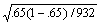 = .0157. For 2
we would assume mean p2 and standard deviation
= .0157. For 2
we would assume mean p2 and standard deviation 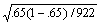 = .0156.
(l) Sample results are shown below
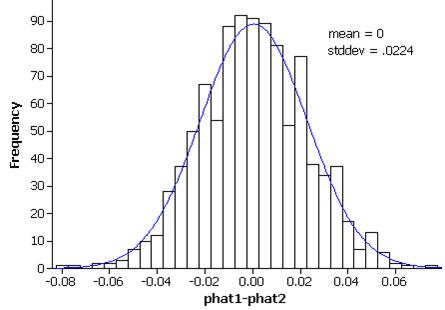
The distribution looks reasonably well modeled by a normal distribution with mean 0 and standard deviation .022.
(m) About 3 or 4% of the simulated differences were larger than .04. This would lead to a p-value below .05 and we would conclude that the difference in the sample proportions did not occur by chance alone. The difference in sample proportions is statistically significant and we can generalize these results to the 1998 and 2002 populations since the samples were selected at random. This is an observational study and not an experiment so we cannot make any causal statements as to why this decline has occurred.
Investigation 5.1.2:
Newspaper Credibility Decline (cont.)
(a) Results will vary but should be similar to the theoretical values.
(b) E(1
– 2)
= E(1)
– E(2)
(by rules of expected value)
= E(X/n1) – E(Y/n2) (by
definition of )
= E(X)/n1 – E(Y)/n2 (by rules of expected value)
= n1p1/n1
– n2p2/n2 (by definition of expected value of binomial
random variable)
= p1-p2
V(1
– 2)
= V(1)
– V(2)
(since the samples are independent)
= V(X/n1) + V(Y/n2) (by
definition of )
= V(X)/n12 + V(Y)/n22 (by rules of variance
= n1p1(1-p1)/n12
+ n2p2(1-p2)/n22 (by definition of variance of binomial random
variable)
= p1(1-p1)/n1 + p2(1-p2)/n2
(c) With n1 = 922 and n2 = 932, p1=p2=.65,
E(1-2)
= p1-p2
= .65 -.65 = 0 which is the average of the simulated differences.
V(1-2)
= p1(1-p1)/n1
+ p2(1-p2)/n2 = .65(.35)/922 +
.65(.35)/932 = .000491
SD(1-2)
= sqrt(.000491) = .0222 which is very similar to the standard deviation of the
simulated differences.
(d) test statistic possibility: 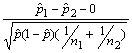
Since the sampling distribution is approximately normal, we can compare this test statistic to the standard normal distribution to obtain a p-value.
(e) = (618+591)/(922+932) = .6521
SE(1-2)
= sqrt(.6521(1-.6521)(1/922+1/932)) = .0221
z = (.670-.634)/.0221 = 1.63
p-value = P(Z>1.63) = .052
The standard error is close to the simulated value and the p-value is in the ball park of the simulated value.
(f) With a small p-value (less than .05), we have strong enough evidence (at the 5% level of significance) to reject the null hypothesis and conclude that the population proportion who rate their daily papers as largely believable decreased between 1998 and 2002.
(g) SE(1-2)
= sqrt(.6703(1-.6703)/922 + .6341(1-.6341)/932) = .0221
90% confidence interval: .6703-.6341 + 1.645(.0221) = .0362 + .0364 = (-.0002, .0726)
(h) We are 90% confident that the difference in the population proportions (p1-p2) is between -.0002 and .0726. That is, between 0% and 7.3% fewer people rate their daily paper as largely believable in 2002 compared to 1998.
(i) If we were to repeatedly draw samples from these populations and calculate a confidence interval for the population difference each time, roughly 90% of these intervals would succeed in capturing the true difference.
(j) Yes, zero is not contained in the 90% confidence interval, consistent with rejecting the null hypothesis p1-p2 = 0 at the 5% level of significance.
(k) The 95% confidence interval: .6703-.6298 + 1.96(.0221) = .0405 + .0433 = (-.0028, .0838)
This interval is wider than the 90% confidence interval (and in fact now includes 0 as a plausible value of the difference in the population proportions).
(l)  1 = 619/924 = .6699 2 = 592/934 = .6338,
SE(1-2) = sqrt(.6699(1-.6699)/924 + .6338(1-.6338)/934)
= .0221
95% confidence interval: .6699 - .6338 + 1.96(.0221) = .0361 + .0433 = (-.0072, .0794)
We are 95% confidence that the difference in the population proportions is between -.0072 and .0794. This interval is similar to the Wald interval.
(m) Minitab output:
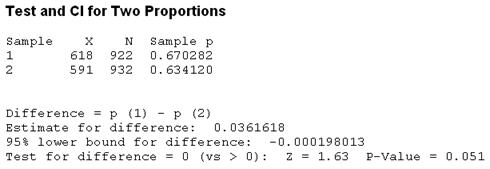
(n) Wald: 95% CI for difference: (-0.00292560, 0.0838329)
(o)
with
(p) Applet:
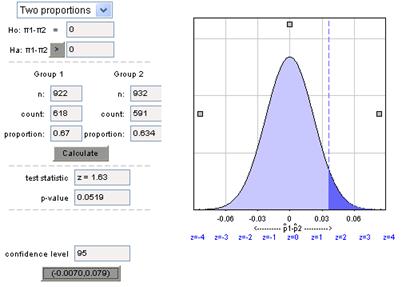
Investigation 5.1.3:
Sleepless Drivers
(a) Observational units: drivers
Variables: whether had a full night’s sleep during the previous week, whether or not involved in a crash resulting in injury.
Will probably consider the sleep variable as the explanatory variable.
(b) Observational since the sleep variable was not imposed by the researchers.
(c) Case-control since they identified cases (those involved in car crashes) and controls (not involved in car crashes that resulted in injury).
(d) We can consider these as independent samples from those who obtained a full night’s sleep and those that did not.
(e) No since this is a case-control study and the proportion of drivers involved in accidents in this study was determined by the researchers.
(f) H0: t = 1 (there is no association between sleep variable and accident variable)
Ha: t > 1 (there is a positive association, those with less sleep have higher odds of being involved in an accident)
(g)
|
|
No full night’s sleep in past week |
At least one full night’s sleep in the past week |
Sample sizes |
|
Case drivers |
61 |
474 |
535 |
|
Control drivers |
44 |
544 |
588 |
|
Total |
105 |
1018 |
1123 |
(h) Sample odds ratio: (61/44)/(510/544) = 1.59
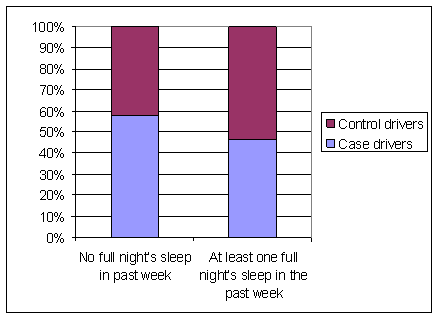
The odds of being involved in an accident are 1.59 times higher for those who did not get a full night’s sleep in the past week. The sample odds ratio is above one but not largely so.
(i) Example results:
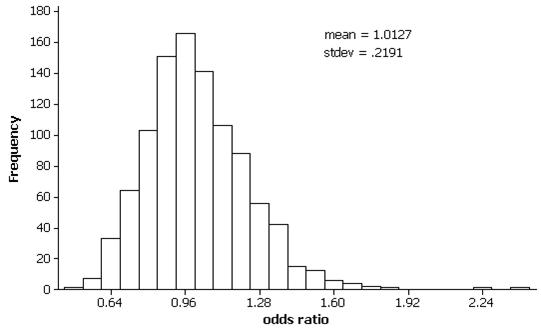
Description appears skewed to the right but the mean is close to the hypothesized value of 1.
(j) The above results have 27 of 1000 values as large or larger than 1.48, empirical p-value .027. This p-value would give moderate evidence to reject the null hypothesis and conclude that there is an association between the sleep variable and the accident variable.
(k) Example results:
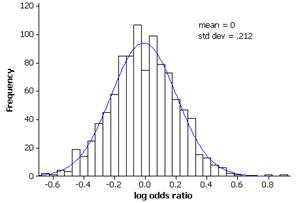
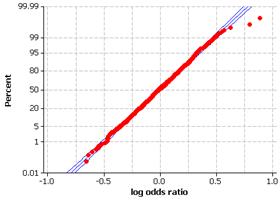
The distribution is approximately normal with mean approximately zero and standard deviation .212. We would predict a mean around zero since log(1) = 0.
(l) SE(log-odds) = sqrt(1/61 + 1/474 + 1/44 + 1/544) = .2075
This is similar to the value from the above simulation (.212).
(m) sample log odds = ln(1.59) = .4637
.4637 + 1.645(.2075) = .4637 + .3413 = (.122, .805)
We are 90% confident that the population log odds ratio is between .122 and .805.
(n) e.122 and e.805 gives a 90% confidence interval for the population odds ratio of (1.13, 2.24). We are 90% confident that the population odds ratio is between 1.13 and 2.24.
Investigation 5.2.1:
Letrozole and Breast Cancer
(a) The women in this study were most likely volunteers and were not randomly selected from the populations of letrozole users and placebo users.
(b) This is an experiment since the women were randomly assigned to letrozole or placebo.
(c) H0: d= 0 (no treatment effect)
Ha: d > 0 (the underlying rate of disease free survival is larger with letrozole than with placebo)
(d) Type I Error = we believe that the letrozole therapy is helpful when really it is not.
Type II Error = we fail to detect that the letrozole therapy is helpful when we should
(e) Yes, we have a randomized experiment and a two-way table.
(f) If we focus on the placebo group, we want to find P(X<2241)
Hypergeometric
with N = 5157, M = 4631, and n = 2582
x
P( X <= x )
2241 0.0000000
with such a
small p-value, we reject the null hypothesis and conclude that the underlying
rate of disease free survival is larger with letrozole than with placebo.
(g) Example
results:
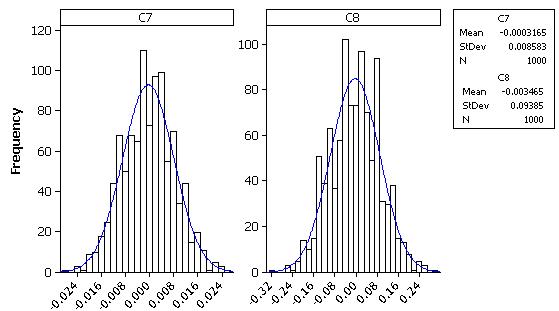
Both empirical randomization distributions appear to be reasonably well modeled by a normal distribution.
(h) Example results: 0/1000 = 0
(i) group X
N Sample p
0 2390
2575 0.928155
1 2241
2582 0.867932
Difference = p (0) - p (1)
Estimate for difference: 0.0602235
95% CI for difference: (0.0437913, 0.0766557)
Test for difference = 0 (vs
not = 0): Z = 7.18 P-Value = 0.000
Both p-values are essentially zero.
(j) exp(ln(1.966) + 2.576sqrt(1/2390 + 1/2241 + 1/185 + 1/341))
= exp(.676 + .247)
= (1.54, 2.52)
We are 99% confident that the underlying odds of disease free survival with letrozole are 1.54 to 2.52 times larger than the underlying odds of disease free survival with the placebo.
Investigation 5.3.1: NBA Salaries
(a) Obs units = NBA players
variable 1 = salary
“variable 2” = conference
These data constitute populations since they are for all players that season.
(b)
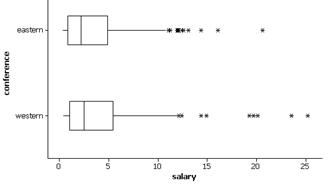
Variable conference
N N* Mean
StDev Minimum Q1
Median Q3
salary eastern
215 0 3.580
3.773 0.337 0.833
2.154 4.850
western 197
0 3.960 4.396
0.349 0.996 2.437
5.400
Variable conference
Maximum Range IQR
salary eastern
20.630 20.292 4.017
western 25.200
24.851 4.404
Both distributions exhibit a slight skew to the right in the salaries. The distributions appear to have similar centers but the Western conference distribution has slightly more variability in the player salaries.
(c) Sample averages often follow normal distributions. The sample size is not large but the data are not extremely skewed either.
(d) Example results:
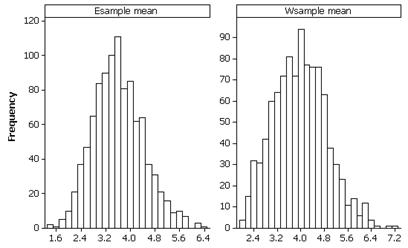
Variable N
N* Mean StDev
Minimum Q1 Median
Q3
Esample mean 1000
0 3.6212 0.8146
1.4519 3.0229 3.5848
4.1499
Wsample mean 1000 0
3.9660 0.9057 1.9165
3.3034 3.9360 4.6016
Variable Maximum
Range IQR
Esample mean 6.3541
4.9022 1.1270
Wsample mean 7.2960
5.3795 1.2982
Both distributions have a slight skew to the right. The centers are similar to the population means but the standard deviations are smaller.
(e)
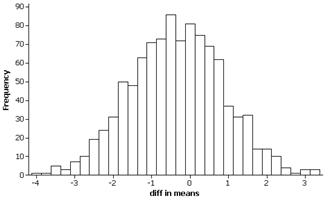
Variable N
N* Mean StDev
Minimum Q1 Median
Q3
diff in means 1000
0 -0.3449 1.2072
-4.0075 -1.1656 -0.3370
0.4809
Variable Maximum
Range IQR
diff in means 3.2271
7.2346 1.6465
The distribution of the differences in the sample means is symmetric with mean equal to the difference in the population means.
(f)
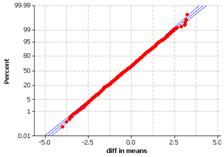
This distribution appears to be quite well modeled by a normal distribution.
(g) E( -  ) = E() – E() by rules of
expectation
) = E() – E() by rules of
expectation
= m1 – m2 (since and are unbiased
estimators of m1 and m2)
(h) V( - ) = V() + V() by rules for variances with independent random variables
= sx2/nx + sy2/ny
SD( - ) = sqrt(sx2/nx + sy2/ny)
(i) 3.58 – 3.96 = -.38
sqrt(3.7732/20 + 4.3962/20) = 1.295
These should be pretty close to the simulated values.
(j) Possible suggestion 
(k) t since that’s what happened before?
(l)
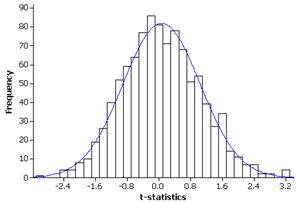
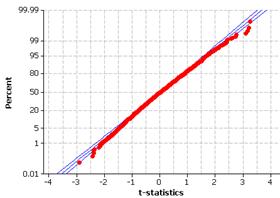
The distribution looks close to normal but again we see a little bit of heaviness in the tails suggesting that a t distribution might be the more appropriate model.
(m) Example results:
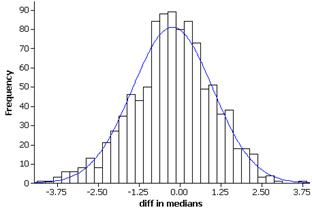
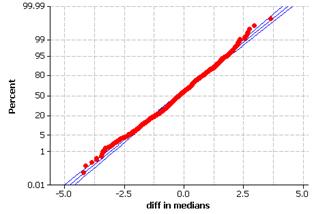
The distribution of the differences in medians are reasonably symmetric but show a bit more deviation from normality than the means.
Investigation 5.3.2:
Handedness and Life Expectancy
(a) This is a retrospective observational study. This implies that we will not be able to draw cause and effect conclusions from the results.
(b) These samples were not selected independently but membership in one group was not affected by membership in the other group so we will be willing to consider them as independent samples.
(c) This is crucial information for us to get a handle on the expected amount of sampling variability before we can decide if a difference of 75 vs. 66 is significant in a statistical sense.
(d) H0: mL = mR (no difference in the mean lifetime of left-handers and right-handers)
Ha: mL < mR (the average lifetime of left-handers is smaller than that of right-handers)
(e) Calls for speculation.
(f)
|
Scenario |
|
Sample sizes |
Sample means |
Sample SDs |
t-statistic |
p-value |
Significant at 10% level? |
|
1 |
left |
99 (10% of 987) |
66 |
15 |
-5.66 |
.000 |
Yes |
|
right |
888 |
75 |
15 |
||||
|
2 |
left |
50 (5% of 987) |
66 |
15 |
-4.13 |
.000 |
Yes |
|
right |
937 |
75 |
15 |
||||
|
3 |
left |
50 (5% of 987) |
66 |
25 |
-2.48 |
.008 |
Yes |
|
right |
937 |
75 |
25 |
||||
|
4 |
left |
10 (1% of 987) |
66 |
25 |
-1.13 |
.143 |
no |
|
right |
977 |
75 |
25 |
||||
|
5 |
left |
99 (10% of 987) |
66 |
50 |
-1.70 |
.046 |
Yes, but |
|
right |
888 |
75 |
50 |
When the sample size for the left handers is larger, we have more evidence against the null hypothesis (larger t-statistics, smaller p-values). When the sample standard deviations are larger, we have less evidence against the null hypothesis.
(g) Probably scenario 1 or 2 as they have more a more realistic percentage of left-handers and the sample standard deviation is more reasonable (the others are too large if we are expecting about 35% of data values to fall more than one standard deviation above or below the mean – we probably aren’t expecting a normal distribution, but these standard deviations still feel too large).
(h) For even of the remotely realistic scenarios, the p-values were quite small indicating statistical significance.
(i)
For scenario 1: 95% CI
for difference: (-12.14685, -5.85315)
We are 95%
confident that the average lifetime for right handers exceeds that of left
handers by 5.8 to 12.1 years.
(j) For
those who would be in their eighties in 1981, many of them would have been
encouraged to not be left handed when they were younger. This would explain why there were fewer
left-handers in the older age groups.
(k) Can’t
impose whether or not someone is left handed.
Investigation 5.3.3: Comparison
Shopping (cont.)
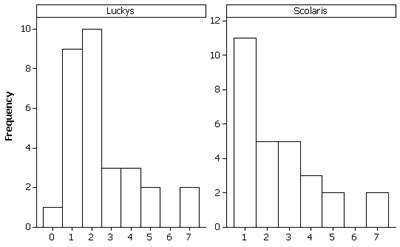
Variable N
N* Mean StDev
Minimum Q1 Median
Q3
Luckys 28
0 2.447 1.745
0.490 1.015 1.990
3.533 6.990 6.500
Scolaris 28
0 2.565 1.767
0.500 1.005 2.145
3.658 6.790 6.290
Variable IQR
Luckys 2.518
Scolaris 2.653
Both prices distributions are skewed
to the right. There is a slight tendency
for Scolari’s prices to be more expensive and the variability in the two
distributions is similar.
(b) H0: mL = mS
(prices are the same on average – for all products common to both storess)
Ha: mL < mS
(on average, prices are less at Lucky’s)
We are skeptical that the
populations follow normal distributions but the shapes are similar and the
sample sizes are close to 30 so we will proceed. The data were a random sample of products.
N
Mean StDev SE Mean
Luckys 28
2.45 1.75 0.33
Scolaris 28
2.57 1.77 0.33
Difference
= mu (Luckys) - mu (Scolaris)
Estimate
for difference: -0.118214
95%
upper bound for difference: 0.667631
T-Test
of difference = 0 (vs <): T-Value = -0.25
P-Value = 0.401 DF = 53
With such a large p-value, we would
fail to reject the null hypothesis. We
do not have significant evidence of a lower average price at Lucky’s compared
to Scolari’s.
(c) We don’t have two independent samples, one from each
store, but instead we have one sample of products that was used at both stores.
(d) This controls for the
variability in prices from product to product.
(e)
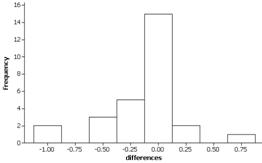
Variable N
N* Mean StDev
Minimum Q1 Median Q3
differences 28
0 -0.1182 0.3588
-1.0000 -0.2750 0.000000000
0.1000
Variable Maximum
Range IQR
differences 0.7600
1.7600 0.3750
Most of the differences are around
zero but the mean is slightly negative.
The distribution of the differences is fairly symmetric.
(f) Let m = average price difference (Lucky’s
– Scolari’s)
H0:
m = 0 (no price difference on average
– for all the products common to both stores)
Ha:
m < 0 (Lucky’s tends to have lower
prices than Scolari’s, on average)
95% Upper
Variable N
Mean StDev SE Mean
Bound T P
differences 28
-0.118214 0.358774 0.067802
-0.002728 -1.74 0.046
With a
p-value of .046, we have moderate evidence against the null hypothesis. At the 5% level of significance, we would
conclude that the average price difference favors Lucky’s.
(g) The
test statistic is larger and the p-value is smaller. The p-value has changed quite a bit.
(h)
|
|
Lucky’s |
Scolari’s |
Difference |
|
Mean |
2.45 |
2.57 |
-.118 |
|
Standard
deviation |
1.75 |
1.77 |
.359 |
The
variability in the differences is much smaller than the variability in the
individual samples. This makes the
difference in the sample means more “standard errors” from the hypothesized difference
of zero.
(i)
Variable N
Mean StDev SE Mean 90% CI
differences 28
-0.118214 0.358774 0.067802
(-0.233701, -0.002728)
We are 90%
confident that the average price savings at Lucky’s is between $.234 and $.003
per item. Comments on practical
significance will vary for individuals.
Would you be willing to pay more for gas to go to Lucky’s? Does it depend on how many items you tend to
buy in one trip?
(j) Using
Minitab:
Sign
test of median = 0.00000 versus <
0.00000
N
Below Equal Above
P Median
differences 28
13 7 8
0.1917 0.00000
We would
easily reject the null hypothesis and say we have statistically significant
evidence that the median price difference is less than zero. More than half of the (differing) prices were
lower at Lucky’s.
Investigation 5.4.1: Sleep
Deprivation (cont.)
(a) H0: d = 0 (no treatment effect)
Ha: d > 0 (lower improvement scores
for sleep deprived group on average)
Two-sample T for improvement
sleep
condition N Mean
StDev SE Mean
deprived 11
3.9 12.2 3.7
unrestricted 10
19.8 14.7 4.7
Difference
= mu (deprived) - mu (unrestricted)
Estimate
for difference: -15.9200
95%
upper bound for difference: -5.7644
T-Test
of difference = 0 (vs <): T-Value =
-2.71 P-Value = 0.007 DF = 19
Both
use Pooled StDev = 13.4420
The p-value
is quite similar to what we found before.
(b) 95% CI for difference: (-28.2128, -3.6272)
We are 95% confident
that the true treatment effect from not getting that first night’s sleep is to
lower the score by 3.63 to 28.21 on average.
(c) No,
these were volunteer college students and may not be representative of a larger
population.
Investigation 5.5.1: Heart
Transplants and Survival
(a)
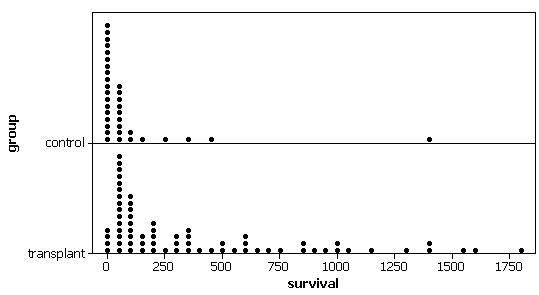
Variable group
N N* Mean
StDev Minimum Q1
Median Q3
survival control
34 0 96.6
250.3 1.00 5.75
21.0 54.8
transplant 69
0 415.3 458.6
5.00 70.0 207.0
645.0
Variable group
Maximum Range IQR
survival control
1400.0 1399.0 49.0
transplant 1799.0
1794.0 575.0
Both distributions are strongly skewed to the right. The average survival appears much larger for the transplant group which also displays much more variability.
(b) It would be difficult to compare the means since there is “truncation” in the data, we don’t have the exact survival times for those still in the clinic.
(c) 207-21 = 186
(d) Example results:
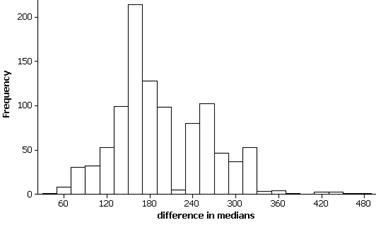
Variable N
N* Mean StDev
Minimum Q1 Median
Q3
difference
in me 1000 0
195.98 67.18 48.00
152.50 176.00 250.00
Variable Maximum Range
IQR
difference
in me 483.50 435.50
97.50
The distribution is irregular and skewed to the right with a mean around 195.95 and a standard deviation of 67.18.
(e) The standard deviation of the empirical bootstrap distribution of the differences in the group medians is: 67.18.
(f) The 25th and the 975th values.
(g) Example results: Sorting the observations, the 25th value was 82 and the 975th value was 322.
(h) This interval does not contain 0 but lies entirely above zero. This provides evidence of a statistically significant difference between the median survival time for those in the treatment group compared to the control group.
(i) If we instead looked at the 50th and 950th values, we get an interval of 95 – 316. This interval is less wide than the 95% bootstrap interval.
(j) Example results:
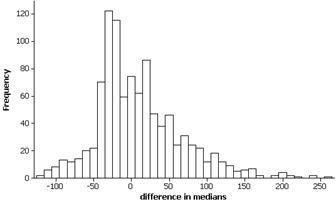
Variable N
N* Mean StDev
Minimum Q1 Median
Q3
difference
in me 1000 0
9.96 56.85 -121.00
-28.50 0.500 39.38
Variable Maximum Range
IQR
difference
in me 256.00 377.00
67.88
(k) 12/1000 or .012 is the empirical p-value for the above simulation.
(l) We have statistically significant evidence that the treatment effect is greater than zero, indicating a longer median survival time for those in the treatment group. This was an experiment so we can draw a cause and effect conclusion.
CHAPTER 6
Investigation 6.1.1:
Dr. Spock’s Trial
(a)
|
|
Judge 1 |
Judge 2 |
Judge 3 |
Judge 4 |
Judge 5 |
Judge 6 |
Judge 7 |
|
Proportion of women |
.336 |
.270 |
.291 |
.341 |
.270 |
.270 |
.144 |
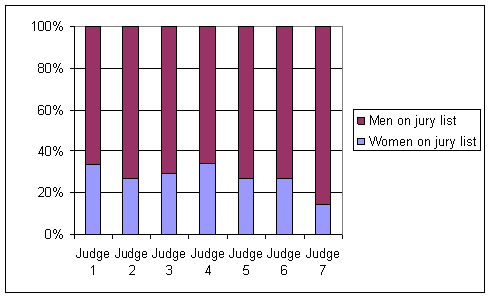
There is some variability in the proportion of women seen by each judge. Judge 7 in particular has a much lower percentage of women on his jury lists.
(b) Let pi represent the probability of a female juror for judge i.
H0: p1 = p2= p3= p4= p5= p6= p7 (all seven judges have the sample probability of a female on the jury list)
Ha: at least one judge has a different probability
(c) The overall proportion of women in this data set is .261.
(d) Judge 1 saw 354 jurors so we would expect .261(354) = 92.39 females out of 354 and 261.61 men.
(e) Judge 2 saw 730 jurors so we would expect .261(730) = 190.53 women and 538.47 men.
(f) The expected counts are given below in red.
|
|
Judge 1 |
Judge 2 |
Judge 3 |
Judge 4 |
Judge 5 |
Judge 6 |
Judge 7 |
|
Women on jury list |
119 92.39 |
197 190.53 |
118 105.71 |
77 58.99 |
30 28.97 |
149 144.07 |
86 155.82 |
|
Men on jury list |
235 261.61 |
533 538.47 |
287 299.30 |
149 167.01 |
81 82.03 |
403 407.93 |
511 441.18 |
|
Total |
354 |
730 |
405 |
226 |
111 |
552 |
597 |
(g) The observed counts and the expected counts differ, however this could be due to random chance.
(h) Suggestions will vary.
(i) The sum is approximately 62.68
(j) This calculation will result in larger values when the null hypothesis is false and smaller values when the null hypothesis is true, but it will always be nonnegative.
(k) Example empirical sampling distribution (1000 observations):
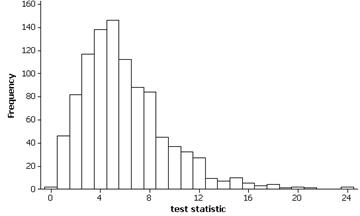
This distribution is skewed to the right. The mean should be around 6.
(l) None of the simulated sums is anywhere near 62.68.
(m) There is strong evidence that these observations do not follow a normal distribution.
(n) The distribution should seem reasonably well modeled by a gamma distribution with parameters approximately 3 and 2.
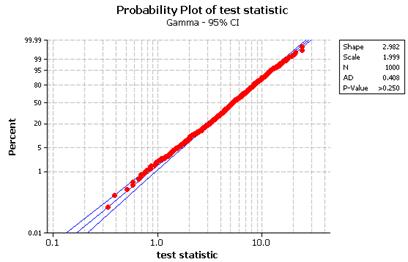
(o) This distribution also provides a reasonable fit.
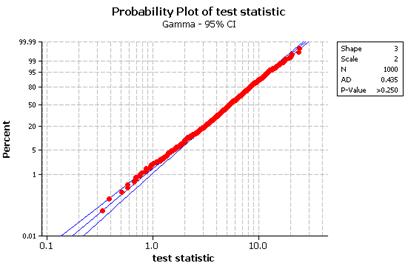
(p)
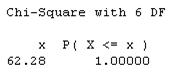
To find the p-value we subtract this result from 1. This indicates a p-value of approximately zero.
The p-value from the chi-square distribution is near the p-value from the empirical sampling distribution.
(q) The contributions from Judge 7’s cells are the largest.
(r) The observed number of women is less than expected and the observed number of men is larger than expected. This provides evidence that the proportion of women for Judge 7 is less than expected, even more so than any of the other judges.
(s) Judge 7.
(t) C(7,2) = 21 comparisons
(u) P(Type I Error) = .05
(v) P(at least one Type I Error) = 1 – P(no Type I Errors) = 1- (.95)21 = .659.
Investigation 6.1.2:
Near-Sightedness and Night Lights (cont.)
(a) hyperopia: .190, emmetropia: .524, myopia: .286
(b) There were 172 children in the darkness condition, so we expect 172(.19) and 172(.524) and 172(.286) or 32.68, 90.13, 49.19 in these 3 conditions.
(c) The proportional breakdown would be the same in all 3 groups if there was no association between eye condition and lighting level.
(d) Expected counts:
|
|
Darkness |
Night light |
Room light |
Total |
|
Hyperopia |
(40) 32.68 |
(39) 44.08 |
(12) 14.25 |
91 |
|
Emmetropia |
(114) 90.13 |
(115) 121.57 |
(22) 39.30 |
251 |
|
Myopia |
(18) 49.19 |
(78) 66.35 |
(41) 21.45 |
137 |
|
|
172 |
232 |
75 |
479 |
(e) They are not the same but it could be due to random chance.
(f)
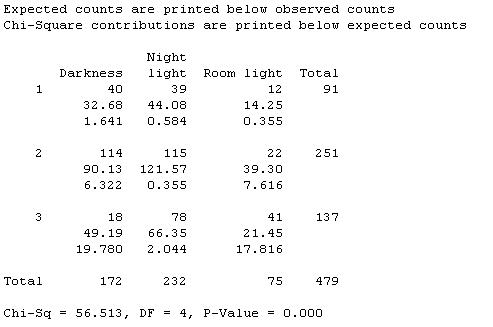
(g) The darkness/myopia cell and the room light/myopia cell have the largest contributions. We observed less myopia in the darkness group and more myopia in the room light group than we would have expected if there was no differences among the lighting groups.
Investigation 6.1.3:
Newspaper Credibility Decline (cont.)
(a) Two-way table:
|
|
2002 |
1998 |
|
|
4 |
200 |
265 |
465 |
|
3 |
391 |
353 |
744 |
|
2 |
251 |
235 |
486 |
|
1 |
90 |
69 |
159 |
|
|
932 |
922 |
|
(b) H0: The distributions of the believability ratings responses in the population were the same in 2002 and 1998.
Ha: There is at least one difference between the distributions.
The expected cell counts (see below) are all above 5 and we have independent random samples from 2002 and 1998.
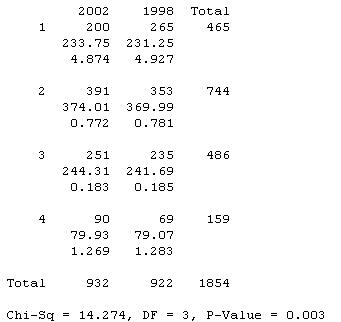
We have strong evidence (p-value = .003) to reject the null hypothesis and conclude that the population distributions did differ.
(c) H0: p98 = p02 vs. Ha: p98 ≠ p02
The expected cell counts are all above 5 (see below) and we have independent random samples from 1998 and 2002.
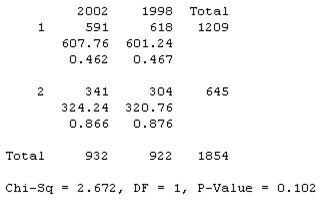
We fail to reject the null hypothesis. There is not convincing evidence that the population proportion who would rate their local paper as largely believable differed in 1998 and 2002.
(d) The test statistic we found before (z = -1.63) is smaller than the chi-squared value but the p-values are identical. In fact, squaring the z test statistic value gives the chi-square test statistic value.
Investigation 6.2.14: Handicap Discrimination
(a) The observational units are undergraduate students and the explanatory variable is the type of handicap, the response variable is the rating of candidate’s qualifications. This is an experiment since the undergraduate students were randomly assigned to view one of the types of handicaps.
(b) Sample size, sample standard deviation
(c) Let mi = the true treatment effect for handicap type i
H0: mamp
= mcrutch = mhear = mnone = mwheel
Ha: at least one of the m’s differs from the rest.
(d) Type I Error = thinking there is a difference in the effect of the handicap types when there is not.
Type II Error = thinking there is a not a difference in the effect of the handicap types when there is.
(e) The distributions appear similar in shape and center but have different amounts of variability within the groups. Graph B shows stronger evidence that the 5 samples did not all have the same overall mean.
(f)
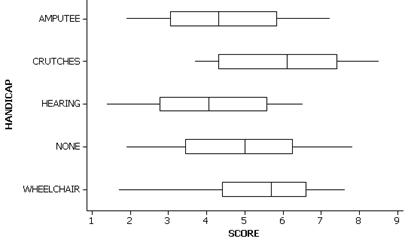
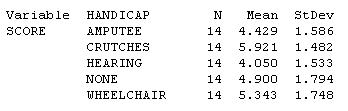
There is some evidence of a difference in the average rating score given to the 5 different handicap types.
(g) The overall mean is 4.929.
(h) variance = .545
(i) Yes since the sample sizes are all equal.
(j) 14(.545) = 7.63
(k) average variance = (1.5862 + 1.4822 + 1.5332 + 1.7942 + 1.7482)/5 = 13.3357/5 = 2.67
(l) Our probability model is to consider the response ratings to be randomly assigned to the 5 treatment groups, so we expect similar variability in the 5 groups. This is confirmed by our observations from the numerical and graphical summaries of the results.
(m) 7.63/2.67 = 2.86
(n) Smallest value is zero which would result if there was no between group variation. There is no upper bound on the value this ratio can assume.
(o) This ratio will be large when the null hypothesis is false and small when it is true (but always nonnegative).
(p) We would put the 70 rating scores on index cards and then randomly assign 14 cards to 5 different groups and see what value of the test statistic we get for each randomization.
(q) Example empirical sampling distribution.
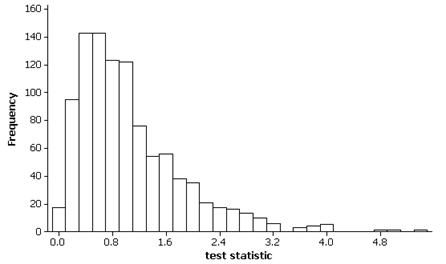
The empirical sampling distribution should be skewed to the right with mean about 1.
(r) Approximate p-value will be approximately .03 giving sufficient evidence to reject the null hypothesis at the 5% level.
(s)
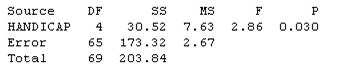
(t)
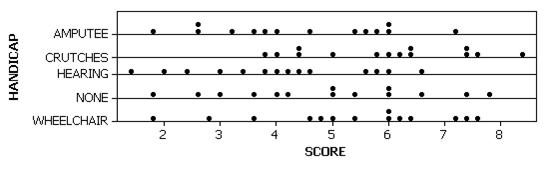
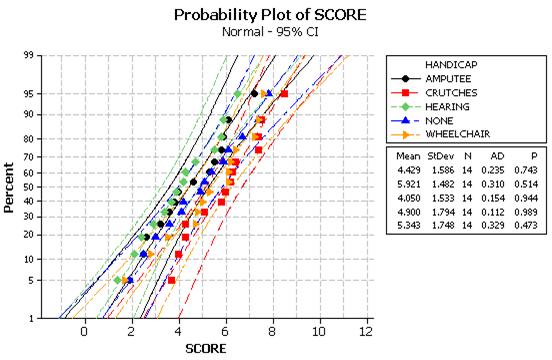
There is no evidence of nonnormality and the ratio of the largest to smallest sample standard deviation (1.794/1.482) is less than 2.
(u) There is moderate evidence that these average qualification ratings differ more than we would expect from the randomization process alone. There is at least one handicap that has a different effect on the qualification ratings than the other handicaps. The ANOVA procedure appears valid since the observed treatment group distributions look reasonably normal and treatment group standard deviations are also similar.
Investigation 6.2.2:
Restaurant Spending and Music
(a) weighted average = [120(24.13) + 142(21.91) + 131(21.70)]/(120+142+131) = 22.52 (this is in the “middle” of the 3 observed averages).
Pooled variance = [119(2.2432)+141(2.6272)+130(3.3322)]/(119+141+130) = 7.73
Pooled std dev = sqrt(7.73) = 2.78 (this is in the “middle” of the observed standard deviations)
(b) H0: the true treatment means (mclass = mpop = mnone) are all equal
Ha: at least one true treatment mean differs
(c) variability between groups = 120(24.13-22.52)2 + 142(21.91-22.52)2 + 132(21.7-22.52)2 /2 = 226
F = 226/7.73 = 29.2
F
distribution with 2 DF in numerator and 390 DF in denominator
x
P( X <= x )
29.3 1.00000
The p-value is approximately zero.
(d) We would need to be able to verify the technical conditions (in fact, there is an issue here in that the treatments were assigned to the evenings and not the individual dinners).
(e) Results will vary.
(f) Results will vary from sample to sample by chance.
(g) It will be possible to obtain a p-value below .05, but should happen less than 5% of the time (by chance alone).
(h) Now all the p-values should be quite small. We should have more evidence against the null hypothesis in this case since it is indeed false.
(i) The p-values tend to be larger, there will be less evidence against the null hypothesis from the smaller sample sizes (more variability due to chance).
(j) Larger values of s lead to larger p-values. This makes sense since larger values of s correspond to more variability in the treatment groups, making it harder to detect differences between the groups.
(k) The p-value will continue to get smaller since it will be easier to detect a difference when the size of the true difference is larger.
Investigation 6.3.1: House Prices
(a) The observational units are the 83 houses in the sample. The primary response variable of interest is the price of the house (quantitative)
(b)
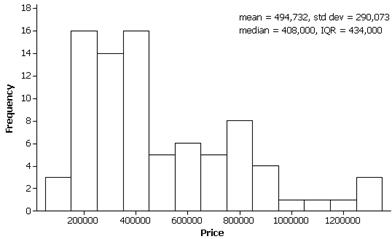
The distribution is skewed to the right with an average house price of around $494,732, a typical house price around $408,000 and an interquartile range of $434,000. The shape makes sense as there will be fewer of the more expensive homes.
(c) Best prediction for minimizing the sum of the square prediction errors would be the mean. The best prediction for minimizing the sum of the absolute prediction errors would be the median.
(d) Yes, there should be a tendency for larger homes to be more expensive.
(e)
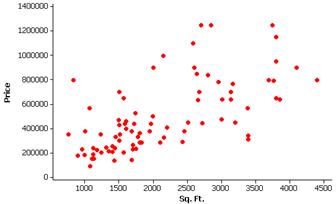
The pattern does seem to give evidence the size of the home is related to the cost of the house and in the expected way.
Investigation 6.3.2:
Drive for Show, Putt for Dough
(a) Negative, golfers that hit further will tend to be the same golfers with lower scores.
(b) Positive, golfers that hit more putts will tend to be the same golfers with higher scores.
(c)
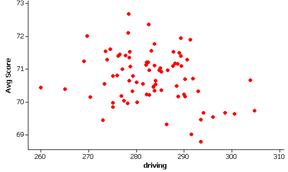
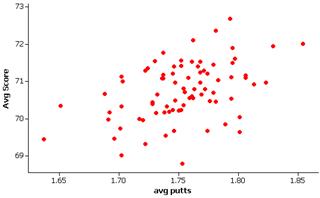
The relationship between average score and driving distance does appear to be negative. The relationship between average score and average putts appears positive and to be stronger than the first relationship.
(d) average score vs. average putts has more points in quadrants I and III
average score vs. driving has more points in quadrants II and IV
There appear to be fewer “unaligned points” in the average score vs. average putts graph.
(e) no measurement units
(f) the points will have random scatter, observations with below average x values will have both below and above average y values, observations with above average x values will have both below and above average y values.
(g) 1
(h) no, involves means, standard deviations, and squared terms, all of which should contribute to it not being resistant to outliers.
(i) rankings may vary
(j)
|
Strong neg |
Medium neg |
Weak neg |
No association |
Weak pos |
Medium pos |
Strong pos |
|
-.835 |
-.715 |
-.336 |
-.013 |
.356 |
.654 |
.884 |
(k) smallest in absolute value: 0, largest in absolute value: 1
(l) r will be negative when the association is negative and positive if the association is positive
(m) no association
(n) perfect linear relationship
(o) scoring average and average putts which does support the cliché that putting is more related to overall scoring.
Investigation 6.3.3:
Height and Foot Size
(a) The observational units are the students, the explanatory variable is the person’s foot length and the response variable is the person’s height.
(b) The mean height of the 20 students: 67.75
(c) No
(d)
|
74 |
66 |
77 |
67 |
56 |
65 |
64 |
70 |
62 |
67 |
|
6.25 |
-1.75 |
9.25 |
-.75 |
-11.75 |
-2.75 |
-3.75 |
2.25 |
-5.57 |
-.75 |
|
66 |
64 |
69 |
73 |
74 |
70 |
65 |
72 |
71 |
63 |
|
-1.75 |
-3.75 |
1.25 |
5.25 |
6.25 |
2.25 |
-2.75 |
4.25 |
3.25 |
-4.75 |
We overestimated 11 times and
underestimated 9 times.
(e) The residual is positive if the
observation is above the fitted value and negative if the observation is below
the fitted value.
(f) Could consider sum of squared
residuals, sum of absolute residuals.
(g) Positive, as expected, those
with above average foot lengths are the same individuals with above average
heights.
(h)-(i) Lines will vary.
(j) Suggestions will vary.
(k) Which line has the smallest SAE
value?
(l) The best (smallest) SSE will
vary.
(m) Equation and resulting SSE
values will vary.
(n) equation:  = 38.302 + 1.033 foot size
SSE = 235
No should have been able to obtain a
smaller SSE value.
(o) Taking the derivative…
(p) derivative with respect to b0: S(-2)(yi – b0 – b1xi)
derivative with respect to b1: S(-2xi)(yi – b0 – b1xi)
(q) Setting to zero
Syi –b1Sxi = nb0 b0 = Syi/n
–b1Sxi/n
Sxiyi –b1Sxi2 = b0Sxi b1 = [Sxiyi- b0Sxi]/Sxi2
(r) b1 = .711(5.00/3.45) = 1.03
b0 = 67.75 – 1.03(28.5) = 38.4
predicted
height = 38.4 +
1.03 footlength
Note: Will be lots of rounding
discrepancies.
(s) if footlength= 28: 38.4 +
1.03(28) = 67.24
if footlength= 29: 38.4 + 1.03(29) = 68.27
difference = 68.27 – 67.24 = 1.03 which is the same as the
slope of the regression line
(t) The slope is the predicted
change in height for foot lengths that differ by 1 cm.
(u) The intercept is the predicted
height for an individual whose foot length is zero, though it is not all that
reasonable to predict someone’s height if their foot length is zero.
(v) predicted height = 38.4 + 1.03(44) = 83.72 footlength
The foot length of 44 cm is very far outside the range of the x values that were in the data set.
(w) SSE( ) = 475.75
(v) 100%(475.75-235)/475.75 = 50.6%
Investigation 6.3.4:
Money Making Movies
(a)
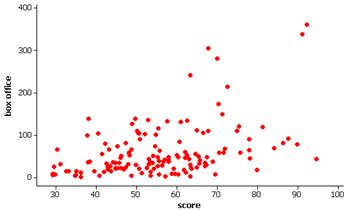
If we treat box office revenue as the response variable there is a moderate positive linear relationship between box office revenue and the critics score.
(b) The moves with the largest residuals include Lord of the Rings and Finding Nemo.
These movies had much higher box office revenues than we would have predicted based on the critics’ score.
(c) The correlation coefficient is r = .424 indicating a moderately strong, positive linear relationship.
(d) The regression equation is predicted box office = - 42.9 + 1.86 score
The intercept is the predicted revenue if the critics’ composite score is 0.
The slope is the predicted increase in box office revenues for a 1 point increase in the critics’ score.
(e) r2 = 18% indicating that the regression on the critics score explains 18% of the variation in the box office revenues.
(f)
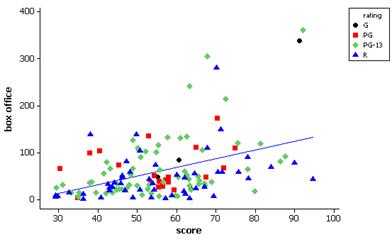
Most of the R movies are below the line. There are only a few G movies. The PG movies tend to be above or very close to the line. (Observations may vary a bit).
(g)
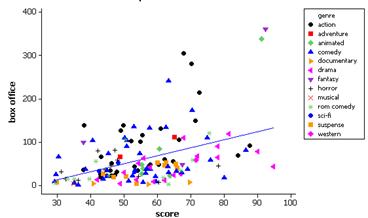
Most of the action movies appear above the line. Most of the dramas appear below the line. (Observations may vary a bit).
(h)
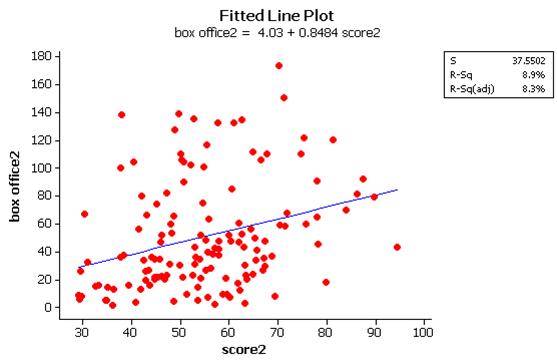
The relationship now appears much weaker (r = .299, only 8.9% of variation explained) but is still positive and linear. Those 6 movies had the effect of making the overall relationship look stronger.
Investigation 6.4.1:
Boys’ Heights
(a) Explanatory variable is age and the response variable is height.
(b) We expect there to be variability in the boys’ heights within ages but we also expect a tendency for the 3 year old boys to be taller than the 2 year old boys in general.
(c) It is possible that the sample slope differs from zero by chance.
(d) We could investigate what the lines look like when we choose random samples from a population where we know the population slope is equal to zero.
(e) population slope would be equal to zero.
(f)
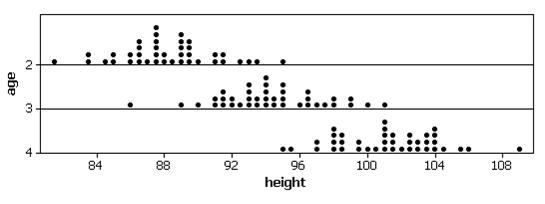
The distributions look roughly normal with similar variability but different centers. The means each differ by about 6.
(g) These conditions do appear to be met for the
Investigation 6.4.2: Housing
Prices (cont.)
(a) The regression equation is predicted price = 65930 + 202 square foot. r2 = 42.1%
(b) Yes
(c)
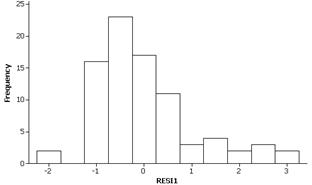
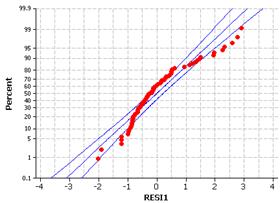
The residuals appear to be skewed to the right and not following a normal distribution.
(d)
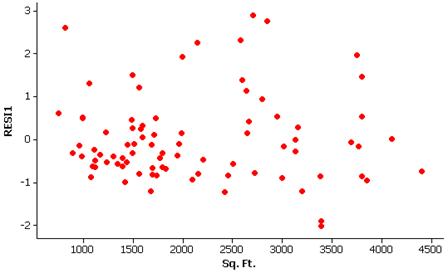
There does not appear to be strong curvature but the spread does appear to increase across the graph.
(e)
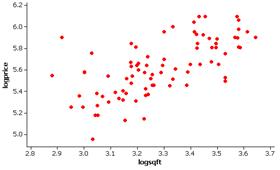
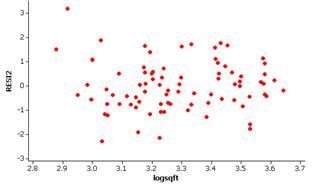
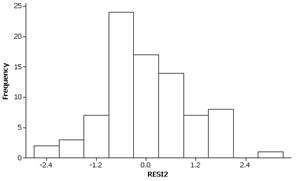
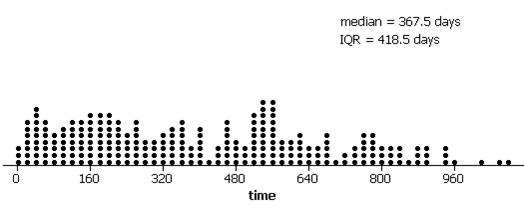
While not perfect, these variables do appear to better follow the basic regression model. The residuals appear less skewed and there is less variation in the “width” of the residuals at different values of the explanatory variable. There does not appear to be any curvature in the relationship either.
(f) The regression equation is predicted logprice = 2.70 + 0.890 logsqft.
If the log square footage increases by one (which corresponds to a
ten-fold increase in square footage), we predicted the log price will increase
by .890 (which corresponds to a 10.89-fold increase in price). If the log square footage is equal to 0
(square footage = 1), the predicted log price is 2.70 (price = 102.70).
(g) predicted logprice = 2.70 + .890 logten(3000) = 5.79
So the predicted price is 105.79
= $623,215.
Investigation
6.4.3: Hypothetical House Prices
(a) Yes it is possible.
(b) b1
= 0
(c) H0: b1 = 0 indicating no relationship
between the size and price of the homes in the population
Ha: b1 ≠ 0 indicating there is a
relationship between the size and price of the homes in the population.
(d)-(e) Regression lines will vary
from sample to sample.
(f) The simulated regression lines
“pivot” around the center of the graph.
(g) Shapes should be roughly symmetric. The mean of the sample intercepts should be around 5.62 and the mean of the sample slopes should be around 0. The standard deviation of the sample intercepts will be around .45-.50 and the standard deviation of the sample slopes will be around .15.
(h) The scatterplot is now not as wide in the vertical direction.
(i)-(j) There should be less swing in the lines vertically resulting in a smaller standard deviation for the sampling distribution of the sample slopes.
(k) There is less spread in the population in the horizontal direction.
(l)-(m) There will be more variability (larger standard deviation) in the regression lines from sample to sample.
(n)-(o) With a smaller sample size, there is more variability in the regression lines from sample to sample.
(p) Yes, n and sX2 are in the denominator and s is in the numerator.
(q) When there is less variation away from the regression line, there will be less variation in the sample regression lines, it is more difficult to get “extreme” regression lines. When there is less variability in the explanatory variable, we are not given as much information about the relationship between the two variables and it will be easier to get more extreme sample results. Larger samples, as always, lead to less sampling variability.
(r) .890 is a very extreme observation (doubtful anyone will ever observe a sample slope at least that extreme) and provides strong evidence that 0 is not a plausible value for the population slope.
(s) Now we may see one or two sample slopes as extreme as what the project group observed but .5 still does not appear to be a plausible value for b1.
(t) Look at the residuals.
Investigation 6.4.4:
House Prices (cont.)
(a) The variability about the regression line (estimate of s)
(b) t = 7.87 and p-value = .000/2 = .000
(c) If we were to repeatedly sample 83 houses from a population where there was no relationship between size and price, we would find a sample slope at least this extreme pretty much never.
(d) .196823*sqrt(1/(82*.192**2) = .1132
(e) t = .8899/.1131 = 7.87 Ö
(f) .8899 + (tn-2 )(.1131) = .8899 + (1.9897)(.1131) = (.665, 1.11)
We are 95% confident that the population slope is between .665 and 1.11 indicating that if we changed the log square footage by one, this is the range of the predicted change in the log price.
(g) The prediction at 2000 will be more precise because
there is less variation in the location of the sample regression line for
values of x closer to .
(h) No, 10,000 is too far outside the range of the explanatory variable values used to derive the least squares equation for this data set.
(i) Predicted Values for New
Observations
New
Obs Fit
SE Fit 95% CI 95% PI
1
5.6343 0.0217 (5.5911, 5.6774) (5.2403, 6.0282)
Values of Predictors for New
Observations
New
Obs logsqft
1
3.30
width =
6.0282 – 5.2403 = .7879
(j) Predicted Values for New Observations
New
Obs Fit
SE Fit 95% CI 95% PI
1
6.0596 0.0598 (5.9406, 6.1786) (5.6503,
6.4689)X
X denotes a point that is an
outlier in the predictors.
Values of Predictors for New
Observations
New
Obs logsqft
1
3.78
width = 6.4689 – 5.6503 = .8186. This interval is wider.
(k)
The 95% CI reported by Minitab is (5.9406, 6.1786)
(see above output).
(l) This interval is narrower as it is “easier” to predict the average price of all homes at that size than to predict the cost of an individual house.